Executive Practice
The Team You Inherit
Assessing Capability, Fit and Trust, and Sequencing the Team You Build
You did not choose them. You are accountable for them.
Judge the team you were given on evidence, then sequence the one you actually need.
Secure checkout via Stripe. Full refund within 14 days if you've completed under 10% of the course.
What you'll learn
- Separate capability from performance, tenure, visibility and articulacy, and explain which of the four is doing the work in your current read of each person.
- Assess capability against a named future role rather than in the abstract, since nobody is a capable executive in general.
- Treat fit as a property of a pair, and identify the roles in your organization that changed without anybody being reappointed to them.
- Distinguish reliability, candour and intent as three independent components of trust, and name which one you are actually missing.
- Build evidence about an individual from what happens when you are not in the room, rather than from what is presented to you when you are.
- Make the disposition judgment across an inherited team: keep, develop, move or exit, with a stated date for each.
- Decide before you are certain, using calibration rather than waiting for a certainty that does not arrive.
- Quantify what a postponed people decision costs and name who is paying it, which is rarely the person postponing.
- Sequence people changes so that the order carries the meaning you intend, and understand what the organization concludes from the gaps between moves.
- Define what you are hiring against as a gap in a composition rather than as a vacancy against a job description.
- Design a standing review of people rather than of performance, and retire the reporting it replaces.
- Apply the instrument in constrained environments where moving somebody is genuinely not available, and at distance where the evidence does not arrive on its own.
The problem this solves
You Were Given Ninety Days and You Formed Your View in Three Weeks.
Every executive entering a role inherits two things.
The first is a business, and there is a discipline for reading it. The second is a set of people they did not select, about whom they will be expected to have a view long before any evidence exists, and for that there is almost nothing. So executives fall back on the two instruments available in the first month: their impression, and other people's opinions.
Both are wrong, and they are wrong in the same direction.
Impression rewards articulacy and proximity. The person who explains their function well in a first meeting is read as capable at running it, and those are different skills that happen to be visible at different rates. Inherited opinion is worse, because it rewards whoever was best at managing the last incumbent, and the last incumbent is the person whose judgment you were brought in to replace.
What happens next is not a failure of intelligence and it follows a pattern precise enough to predict. A first read forms in week three and hardens into a position by week eight. Somebody who presents well is promoted into a role they cannot hold. Somebody quiet and load-bearing is not identified as load-bearing until the week they resign. And the decision everyone could see coming from month two is finally taken in month fourteen.
The Team You Inherit is built on an observation about that fourteen months. The cost of a postponed people decision is paid almost entirely by other people: by the peers absorbing the gap, by the team managing around it, by the customers on the wrong end of it, and by the person themselves, held for a year in a role they were visibly not going to hold. It is paid in a currency that never reaches the executive who postponed it, and nobody sends an invoice. That is the whole reason it is so easy to postpone, and it is why this program treats the timing of a people decision as a design problem rather than a matter of resolve.
This program does not teach you to be ruthless. Its actual finding runs the other way. Most executives are not slow to act because they are kind; they are slow because they have no method, and a decision taken on evidence in month four is materially kinder to everybody involved than the same decision taken on exhaustion in month fourteen.
It is also clear about what it is not. It is not performance management. There are no rating scales here, no calibration sessions, no competency frameworks and no nine-box grid, because those are the apparatus an HR function operates and the moment this subject reads as that apparatus it is handed to HR, which is where inherited-team decisions go to become a process instead of a judgment. And it is not a hiring course: interviewing technique and selection science are a different product for a different buyer.
One boundary is worth stating plainly, because it defines what this program is. It does not teach leadership behaviour. What a leadership team should reward, tolerate and inspect, how to write a behavioural standard that can be inspected, and how to govern behavioural drift are the subject of The Leadership Operating Model, and this program cites it rather than restating it. The distinction is sharp and useful: that program owns the standard a leadership team is held to. This one owns who is on the team.
Across eight modules you build a single connected instrument rather than a set of tools. You will separate capability from the four things routinely mistaken for it, each of which correlates with capability just well enough to be trusted and each of which fails differently. You will stop treating fit as a property of a person and start treating it as a property of a pair, which reframes the most common inherited problem in an organization: a role that changed while nobody reappointed anyone to it. You will separate the three independent things called trust, and be able to say which one you are missing rather than that something feels wrong. You will make the disposition judgment across your team, and understand why the fifth option, waiting, is the only one whose cost you do not personally bear. You will sequence the changes, which matters more than which changes you make, because the organization is reading the order for a rule. And you will design what you are adding against, since a team is a composition rather than a collection of individually excellent people.
Two optional overlays extend the material: one for regulated, unionised, founder-held and capital-constrained environments where the constraint on moving someone is real rather than an excuse, and one for matrix, multi-site and post-transaction teams, where the instrument applies unchanged and the evidence does not arrive on its own.
The program is written for executives at any altitude where the people reporting to them were appointed by somebody else: a new chief executive, a divisional or functional leader on appointment, an operating partner placing a leader into a portfolio company, and any executive who has absorbed a team through reorganization or acquisition. It is also legitimately bought well outside a transition, and the second most common reader is the executive who has realised that the team they have is the team they inherited and never actually reappointed.
One thing is worth saying at the outset. This course will probably show you that you already know which decision you are avoiding, that you have known for some months, and that what you have been waiting for is not more evidence but permission. The method here supplies the evidence anyway, because the evidence is what makes the decision defensible to everybody else. But do not be surprised if the finding is one you recognise.
Who this is for
Three ways in
For yourself
Any executive who has just taken a role where the people reporting to them were appointed by somebody else.
$695
For a cohort
HR partners supporting a wave of leadership appointments, where each new leader is making the same judgment alone.
Thirty minutes, no obligation, to work out whether this is the right program before you put anyone through it.
Book a callFor your company
Private equity operating teams and groups placing leaders into businesses they did not build.
Volume pricing, invoicing and a written proposal. Buying seats directly is on the card above.
Request a proposalRequest a proposal
Tell us roughly what you need and we will send a written proposal. You do not need an account.
The method
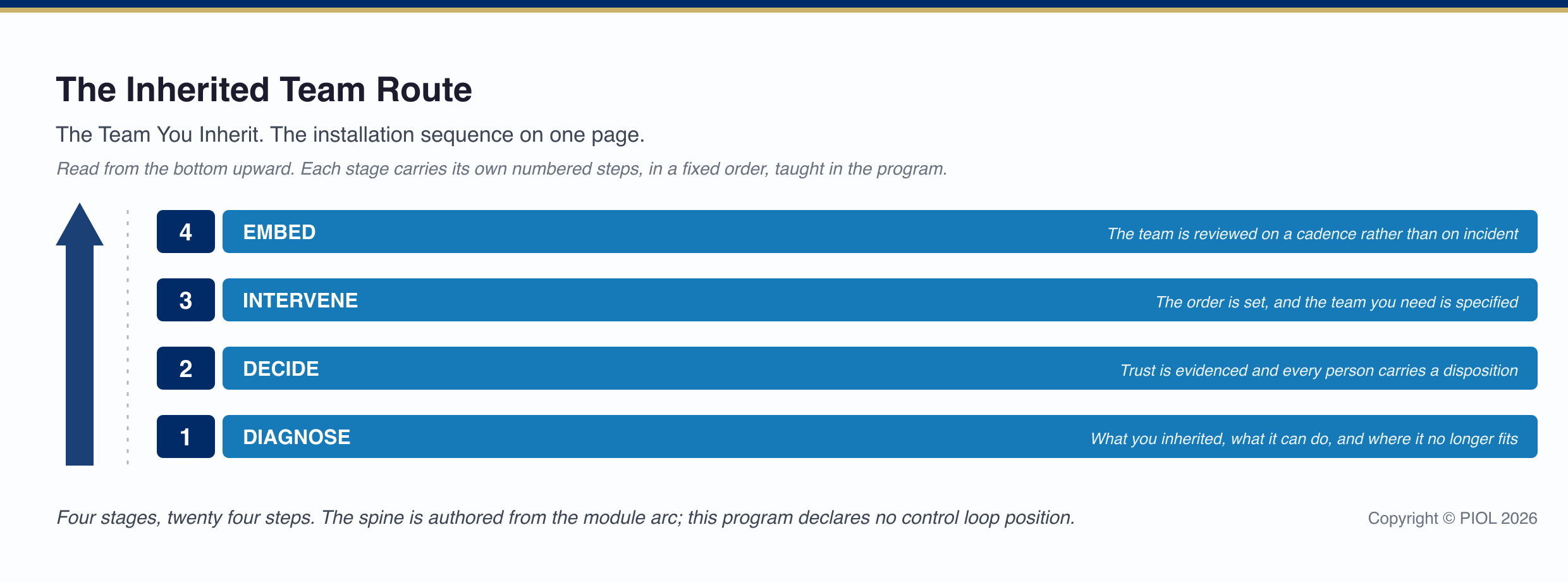
The Inherited Team Route
This program installs a method in a fixed order. Each stage carries its own numbered steps, and each step produces something you keep.
Curriculum
10 modules · 28 lessons
- The Team You Did Not Choose12 minPreview
- Why the First Read Is Wrong in a Predictable Direction12 min
- What You Are Actually Assessing12 min
Includes: Quiz · Self-assessment · Field assignment · Worksheet
A taste: your free preview
The Team You Did Not Choose
An executive arrives with authority over a group of people selected by somebody whose judgment they were brought in to replace, and is expected to have a view long before any evidence exists.
Introduction
Consider what an executive is actually handed on their first day.
A business, with its numbers, its customers and its commitments. And a set of people, every one of whom was selected, promoted or tolerated by the previous incumbent, which is to say by the person whose judgment the appointment exists to replace.
That second inheritance is rarely described as an inheritance. It is described as "the team", as though it were a fixed feature of the organization rather than the accumulated residue of somebody else's decisions, some of them made a decade ago for reasons nobody now remembers.
Founding Principle: An executive is expected to have a view on the people they inherited long before they have evidence about them, and the two instruments available in that window, impression and inherited opinion, are wrong in the same direction. Both reward the person who was best at managing the last incumbent.
The Asymmetry in the First Ninety Days
There is a well-developed discipline for reading an organization on arrival. Executive Organizational Intelligence™ is built on it: how signal travels, where it dies, what the system will and will not let a new arrival see. An executive who has done that work arrives with a genuine method.
For the people, there is almost nothing of the kind, and the gap has a specific consequence. In the absence of a method, an executive uses whatever is available, and in the first month exactly two things are available.
Their own impression, formed in meetings, which are the one setting where everybody is performing.
Other people's opinions, inherited from the organization, which encode a decade of history the new arrival cannot see.
Neither is worthless. Both are systematically biased, in ways the next lesson takes apart properly. What matters here is structural: an executive with no method does not therefore suspend judgment. They form a view anyway, on whatever the first three weeks supplied, and then spend the following year defending it.
Why It Is Not Reasonable to Simply Wait
The obvious response is to withhold judgment until real evidence arrives. It sounds disciplined and it does not survive contact with the role.
The organization will not wait. Decisions requiring a view on people begin in the first fortnight. Who presents to the board. Who leads the thing that matters most this year. Who is told first. Each of those is a judgment about capability, made whether or not the executive intended to make one, and each is read by everybody as a verdict.
Withholding is itself a signal, and not a neutral one. A leader who visibly forms no view for six months is not read as rigorous. They are read as unable to tell, which is a judgment about them.
And the licence expires. There is a window in which an executive can act on people decisions and have it attributed to the transition. It closes somewhere around the end of the first year. After that, the same decision is attributed to them personally, and it costs several times as much to make.
So the answer is not to suspend judgment. It is to form the view faster and on better evidence, which is a harder discipline and the one this program is about.
What Makes This Inheritance Different From Any Other
Three properties, and they are what make people decisions behave unlike every other executive decision.
The asset can leave. No other inherited asset can decide to go somewhere else, and the ones most able to leave are usually the ones you would least like to lose. The read is therefore on a clock that is not yours.
The assessment changes the thing being assessed. An executive who suspects somebody is not up to the role behaves differently toward them, gives them less, checks more, and thereby produces some of the evidence they were looking for. This has no analogue in reading a balance sheet.
The cost of being wrong is asymmetric and delayed. Keeping somebody who should have gone costs a year of quiet damage nobody bills you for. Removing somebody who should have stayed costs immediately, visibly, and in a way everybody attributes to you. Those two error costs are not symmetric, and the asymmetry is exactly why executives make the first error far more often than the second.
The Reappointment That Never Happens
One observation before the method starts, because it widens the audience for everything that follows.
An executive who has held a team for three years usually assumes the inherited-team problem is behind them. It is generally not, because the question was never actually asked. The people who were there on day one are mostly still there, and the ones who remained did so because nothing forced a decision, which is a different thing from having been chosen.
The useful test is one sentence, and it is uncomfortable in a productive way.
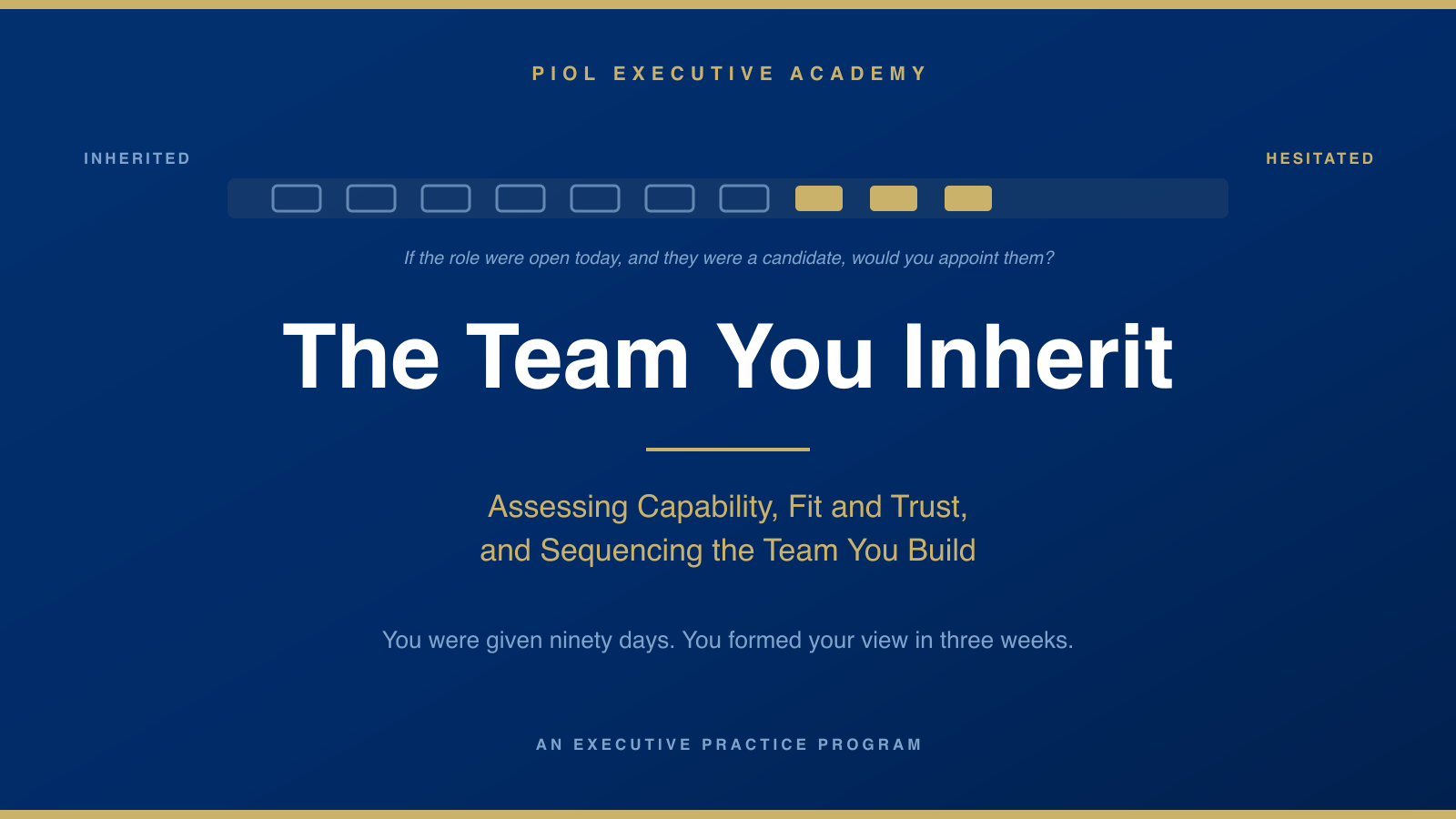
For each person reporting to you: if the role were open today, and they were a candidate, would you appoint them?
That question does not require a transition. It works on any team of any age, and executives who ask it honestly about a team they have led for years are frequently surprised by how many names produce a hesitation. A hesitation is not a verdict. It is a flag that a decision has been made by default rather than on purpose, which is precisely the condition this program exists to interrupt.
Try This Before the Next Lesson
Write out every person who reports to you directly.
Beside each name, write who appointed them, and roughly when. Not to assign blame, but because the pattern is informative: a team appointed entirely by one predecessor carries that person's preferences, including their blind spots.
Then answer the reappointment question for each, in one word: yes, no, or hesitate. Do it quickly. A considered answer here is usually a defended one.
Count the hesitations. That number is the working scope of this course, and in most teams it is larger than the executive expected before they wrote it down.
Key Insight
An executive inherits two things: a business, for which a discipline exists, and a set of people selected by the person whose judgment the appointment exists to replace, for which there is almost nothing. In the absence of a method they use the two instruments the first month supplies, impression and inherited opinion, and form a view anyway. Waiting is not available as an alternative. The organization begins requiring people judgments in the first fortnight, visibly forming no view reads as being unable to tell rather than as rigour, and the transition licence that lets a people decision be attributed to circumstance rather than to the executive personally closes somewhere around the end of the first year. The answer is not to suspend judgment but to form it faster and on better evidence.
Key Takeaways
Three properties make people decisions behave unlike any other executive decision. The asset can leave, and the people most able to leave are usually the ones you would least like to lose, so the read is on a clock that is not yours. The assessment changes what is being assessed, because an executive who suspects somebody is not capable gives them less and checks more, and thereby manufactures part of the evidence they were looking for. And the two error costs are asymmetric: keeping somebody too long costs a year of quiet damage that nobody bills you for and that is paid by peers, by the team and by customers, while moving somebody too early costs immediately, visibly, and with your name on it. That asymmetry is why executives make the first error far more often than the second. The problem is also not confined to transitions: the reappointment test, asking whether you would appoint each person if the role were open today, works on a team held for years, and the hesitations it produces mark decisions that were made by default rather than on purpose.
PIOL Principle #1: The people you inherited were selected by the judgment you were appointed to replace, and the ones who remain are not those who were chosen but those about whom nothing ever forced a decision.
Want the rest of the course? Sign in or create an account, then enroll.
Ready to start?
$695 for full lifetime access. Full refund within 14 days if you've completed under 10% of the course.