Executive Practice
Strategy to Execution
Converting Strategic Intent into Owned Work, and Making Room for It
You set the direction twice. The organization carried on as before.
Convert strategic intent into owned work, and make the room it needs by stopping something.
Secure checkout via Stripe. Full refund within 14 days if you've completed under 10% of the course.
What you'll learn
- Explain why a strategy everyone agreed with is usually one that cost nobody anything, and why that predicts it will not execute.
- Distinguish a strategic choice from an aspiration, using a test most strategy documents fail.
- Write the exclusion list a genuine choice implies, and hold the conversation with the people who lose by it.
- Count the work your organization has already committed, against the capacity it actually has.
- Explain why strategic work loses to operational work every week without anybody deciding that it should.
- Identify the small number of people every initiative silently depends on, and treat them as the constraint they are.
- Build a stop list, and recognize why stopping is structurally harder than starting.
- Stop something well, so that the decision holds rather than being quietly reversed by de-resourcing.
- Complete the chain from a stated strategic choice to a named person's changed week, and find where yours breaks.
- Separate a sponsor from an owner, and state what an initiative must prove before it is funded further.
- Sequence a portfolio on dependency and capacity, and protect that sequence when pressure arrives.
- Distinguish activity completed from movement achieved, and assemble evidence that a choice is taking effect.
The problem this solves
Ask What You Stopped Doing. The Silence Is the Whole Problem.
Every leadership team can describe its strategy. Ask a different question, and the room changes.
What did we stop doing when we adopted it?
The answer is almost always nothing, and the reason it is nothing is not indifference or poor discipline. It is that stopping was never part of the conversation. The strategy was presented, discussed and agreed, and agreement was easy because nobody in the room was asked to give anything up. A set of new priorities was added to an organization that was already, by any honest measure, entirely full.
What happens next is not a mystery, and it is not a failure of will. Strategic work and operational work compete for the same finite attention. Operational work wins, every week, because operational work has a customer waiting and a consequence today, while strategic work has a consequence in eighteen months and nobody chasing it. So the strategy is never rejected. It is deferred, week after week, by capable people making entirely reasonable decisions about what has to happen before Friday. Eighteen months later the business is doing very close to what it was doing before, the annual cycle comes round, and a new strategy is written by people who conclude that the last one lacked clarity.
It did not lack clarity. It lacked room.
Strategy to Execution is built on the observation that the scarce resource in execution is not money and not clarity. It is capacity, and the willingness to stop things. Two links break in almost every organization, and they are always the same two. Nobody counted what the organization had already committed before adding to it. And nothing was stopped, so the new work had to be absorbed rather than resourced.
This course is therefore unusual in what it spends its time on. Two of its eight modules are about capacity and stopping, which is where courses on this subject normally spend a paragraph before moving to planning technique. That balance is deliberate, because an organization that fixes its translation, its ownership, its sequencing and its measurement while still counting no capacity and stopping nothing will produce a beautifully governed portfolio that does not execute.
It is also clear about what it is not. It is not a strategy course: it takes your choices as given, and whether they are good ones belongs to somebody else. And it is not a programme management course. There is no methodology here, no tooling, no benefits framework and no planning technique. That matters commercially as well as intellectually, because the moment this subject reads as programme management it is delegated to a programme office, which is exactly where strategies go to be reported on rather than executed.
Across eight modules you build a single connected instrument rather than a set of tools. You will test whether your strategy contains a genuine choice or an aspiration wearing the clothes of one, using a test that most strategy documents fail. You will write the exclusion list that a real choice implies, and have the conversation with the people who lose by it, which is the part that is usually skipped and is the part that makes the choice real. You will count the capacity your organization has actually committed, which almost nobody has done, and find the handful of people every initiative silently depends on. You will build a stop list, and understand why stopping is structurally harder than starting and who has to be the one to do it. You will complete the chain from a sentence in a strategy document to a named person's changed week, and find where yours breaks. You will sequence a portfolio on dependency and capacity rather than on enthusiasm, and learn to protect that sequence when the pressure arrives. And you will replace milestone reporting with evidence that the business is actually moving, which are different things and are routinely confused.
Two optional overlays extend the material: one for organizations whose direction has changed and who now hold a portfolio of work commissioned under the old one, and one for groups whose strategy must be executed by business units and acquired companies that never agreed to it.
The program is written for executives in any organization large enough that the person who sets direction is not the person who does the work: chief executives and their direct reports, operations, commercial and technology leaders, corporate development, and the chief of staff and transformation roles that carry this obligation without owning the resource.
One thing is worth saying at the outset. This course will probably show you that your organization has committed to substantially more work than it has capacity to do, and that the excess was created by a series of decisions you personally approved, each of them sensible on the day. That finding is uncomfortable and it is also the good news, because a commitment made by decisions can be released by decisions, which is not true of a shortage created by circumstance.
The outcome is not a better plan.
It is a smaller one, that happens.
Who this is for
Three ways in
For yourself
Executives who have set a direction twice and watched the organization carry on doing what it was already doing.
$695
For a cohort
Transformation offices and L&D functions equipping a leadership group before a planning cycle rather than after it.
Thirty minutes, no obligation, to work out whether this is the right program before you put anyone through it.
Book a callFor your company
Companies running more initiatives than they have capacity for, which is most of them.
Volume pricing, invoicing and a written proposal. Buying seats directly is on the card above.
Request a proposalRequest a proposal
Tell us roughly what you need and we will send a written proposal. You do not need an account.
The method
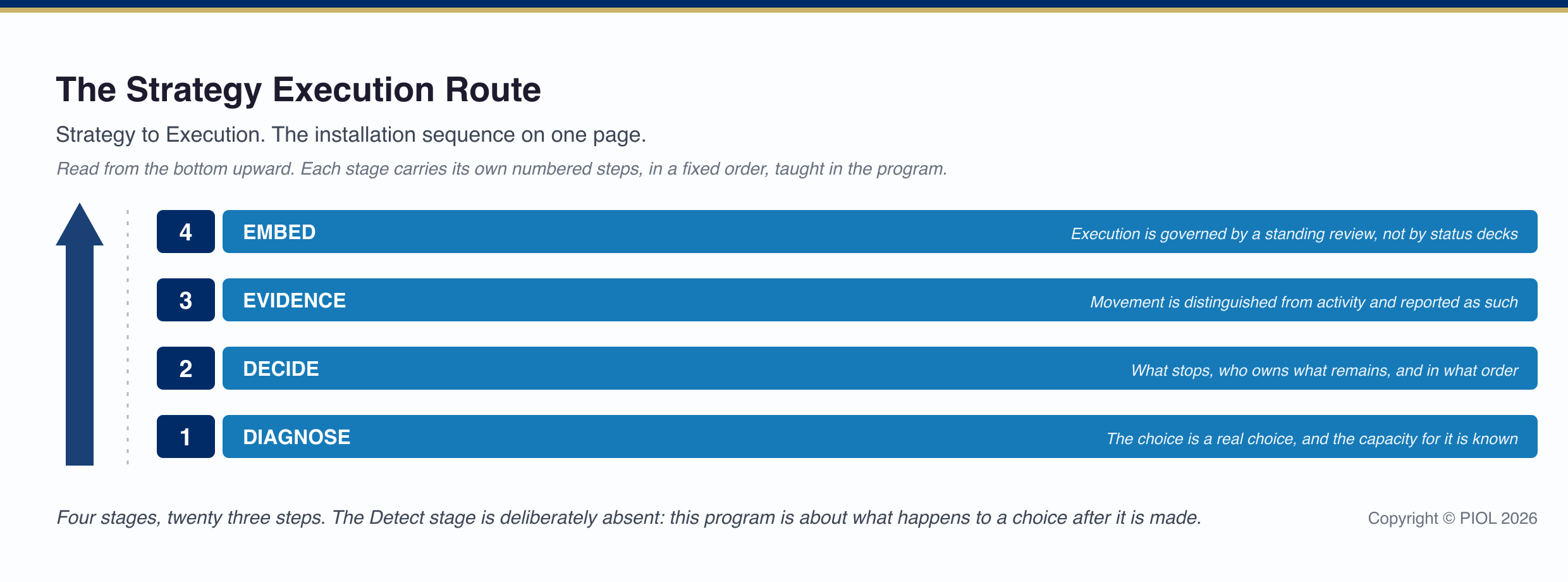
The Strategy Execution Route
This program installs a method in a fixed order. Each stage carries its own numbered steps, and each step produces something you keep.
Curriculum
10 modules · 28 lessons
- The Strategy Everyone Agreed With12 minPreview
- Aspiration Wearing the Clothes of Choice12 min
- Where Strategies Actually Die12 min
Includes: Quiz · Self-assessment · Field assignment · Worksheet
A taste: your free preview
The Strategy Everyone Agreed With
Unanimous agreement on a strategy is not a sign that it is a good one. It is usually a sign that nobody in the room was asked to give anything up, which is the most reliable predictor available that it will not execute.
The Founding Principle: A strategy an organization can agree to without giving anything up has not been adopted. It has been appended to a calendar that was already full, where it will lose every week to work that has a customer waiting.
Everything in this program follows from that sentence. If it is true, the question that predicts execution is not whether people understood the strategy or believed in it. It is what they stopped doing.
Introduction
The strategy day goes well.
The analysis is sound, the direction is credible, and the presentation is good. Each function head speaks in support. There is genuine energy in the room, the kind that is easy to mistake for commitment, and the session closes with agreement that is not merely polite but real. Everybody in that room means it.
Eighteen months later, an honest observer walking the business would struggle to identify which strategy it was operating under. The new capability exists as a small team. The market they were going to enter has a plan and no revenue. The thing they were going to stop is still running at roughly the volume it was. Meanwhile the business has had a good year and a difficult year, absorbed a systems change, replaced two directors, and dealt with three customer escalations that consumed a quarter between them.
Nobody abandoned the strategy. There was no meeting at which it was reversed. It simply did not happen, and the annual cycle now comes round, and a new strategy will be written by people who conclude that the previous one lacked clarity.
Agreement Is Cheap When Nothing Is Traded
Start with what actually happened in that room, because the diagnosis is there rather than in the eighteen months that followed.
Everybody agreed because agreeing cost nothing. The strategy described additions: a capability to build, a market to enter, a segment to serve better. Additions are easy to support. Nobody has to argue against a good idea, and nobody was asked which of their own current commitments would be released to fund it.
So each function head left the room holding the same portfolio of work they arrived with, plus a share of a new one. From their seat, that is not a contradiction. It is what a strategy has always meant, and they will do their best.
This is why unanimity should worry an executive rather than reassure them. A strategy that contains a genuine choice will be opposed by somebody, because a genuine choice takes something away from somewhere. The absence of opposition is not evidence of alignment. It is evidence that nothing was allocated.
The Question That Predicts Execution
There is a single question that separates strategies that happen from strategies that do not, and it can be asked six weeks after adoption.
What did we stop doing?
Not what have we started, which produces a long and encouraging answer. Not what is on track, which produces a status report. What did we stop.
The answers fall into three groups, and the group tells you what will happen.
A specific, named thing, with a date and a person who was doing it. Rare. Predicts execution, because capacity was actually released.
Something small and uncontested. A report nobody read, a meeting nobody valued, a product line already dying. Real, worth doing, and it did not release the capacity the strategy requires, because the things that consume capacity are the things people are attached to.
Nothing, expressed as an intention to be more efficient. The most common answer. It means the new work will be absorbed rather than resourced, which means it will be done in the margins, which means it will be done last.
Why This Is Not a Discipline Problem
The instinct on discovering this is to conclude that the organization lacks execution discipline, and to respond with more rigour: better tracking, tighter reporting, a programme office, a monthly review.
That response fails, and it fails for a reason worth understanding rather than merely noting. Tracking does not create capacity. A weekly report on an initiative that has no time allocated to it produces an accurate weekly record of an initiative with no time allocated to it. The rigour is real and it is being applied to the wrong constraint.
Consider what actually happens to the individual holding both kinds of work. They have a customer escalation today, a board paper on Thursday, a team member resigning, and a strategic initiative with a milestone in November. Every hour they spend on the initiative is an hour not spent on something with an immediate consequence and somebody waiting. They are not being undisciplined when they defer it. They are being sensible, and any competent person in that position makes the same choice.
Deferral repeated by capable people acting sensibly is not a discipline failure. It is an arithmetic outcome, and it can only be changed by changing the arithmetic.
What the Rest of This Program Does
Three things follow, and they map onto the modules.
Establish whether there is a choice at all. Modules 1 and 2. A strategy that contains no exclusion has nothing to execute.
Count the capacity and release some. Modules 3 and 4. This is the part that is normally skipped and is the part that determines the outcome.
Then do the work properly. Modules 5 to 8. Translation, ownership, sequencing, evidence and governance all matter, and all of them are wasted on an organization that has not made room.
The order is not stylistic. An organization that starts at module 5, which is where most execution programmes begin, will build an excellent chain of owned work with no capacity behind it.
Try This Before the Next Lesson
Ask the question, of your own leadership team, and take the answers as given.
What did we stop doing when we adopted this strategy? Ask each of them separately rather than in a meeting, because in a meeting the first plausible answer becomes everybody's answer.
Sort the answers into the three groups. Named and specific, small and uncontested, or nothing.
Then ask yourself the same question, about your own week. If your calendar looks materially the same as it did before the strategy was adopted, that is the most informative single observation available to you, and it is available today.
Key Insight
A strategy day that closes in genuine unanimous agreement is not evidence of alignment but evidence that nothing was allocated, because agreement is cheap when nothing is traded. The strategy described additions, additions are easy to support, and nobody was asked which of their current commitments would be released to fund it, so every function head left holding their existing portfolio plus a share of a new one. A strategy containing a genuine choice will be opposed by somebody, because a genuine choice takes something from somewhere, which is why unanimity should worry an executive rather than reassure them. One question asked six weeks after adoption predicts the outcome: what did we stop doing. The three possible answers, a specific named thing with a date and a person, something small and uncontested, or nothing expressed as an intention to be more efficient, tell you respectively that capacity was released, that it was not released where it matters, and that the new work will be absorbed rather than resourced.
Key Takeaways
Nobody abandons a strategy, and there is rarely a meeting at which one is reversed. It is deferred week by week by capable people making entirely reasonable decisions about what has to happen before Friday, until a new strategy is written by people who conclude the last one lacked clarity. The instinct to respond with more rigour fails because tracking does not create capacity: a weekly report on an initiative with no time allocated to it produces an accurate weekly record of an initiative with no time allocated to it, and the discipline is being applied to the wrong constraint. The individual holding a customer escalation today, a board paper on Thursday, a resignation to handle and a milestone in November is not being undisciplined when they defer the milestone; they are being sensible, and any competent person makes the same choice, which makes this an arithmetic outcome changeable only by changing the arithmetic. The order of the program follows from that: establish whether a choice exists, count the capacity and release some, and only then do the translation, ownership, sequencing and evidence work, because an organization that starts where most execution programmes begin will build an excellent chain of owned work with no capacity behind it.
PIOL Principle #1: Unanimous agreement on a strategy is a warning rather than a result. A choice that takes nothing from anybody has not been made, and the absence of opposition means the absence of allocation.
Want the rest of the course? Sign in or create an account, then enroll.
Ready to start?
$695 for full lifetime access. Full refund within 14 days if you've completed under 10% of the course.