Executive Practice
Safety as Enterprise Signal
Reading Safety Performance as Evidence of How Well the Business Is Run
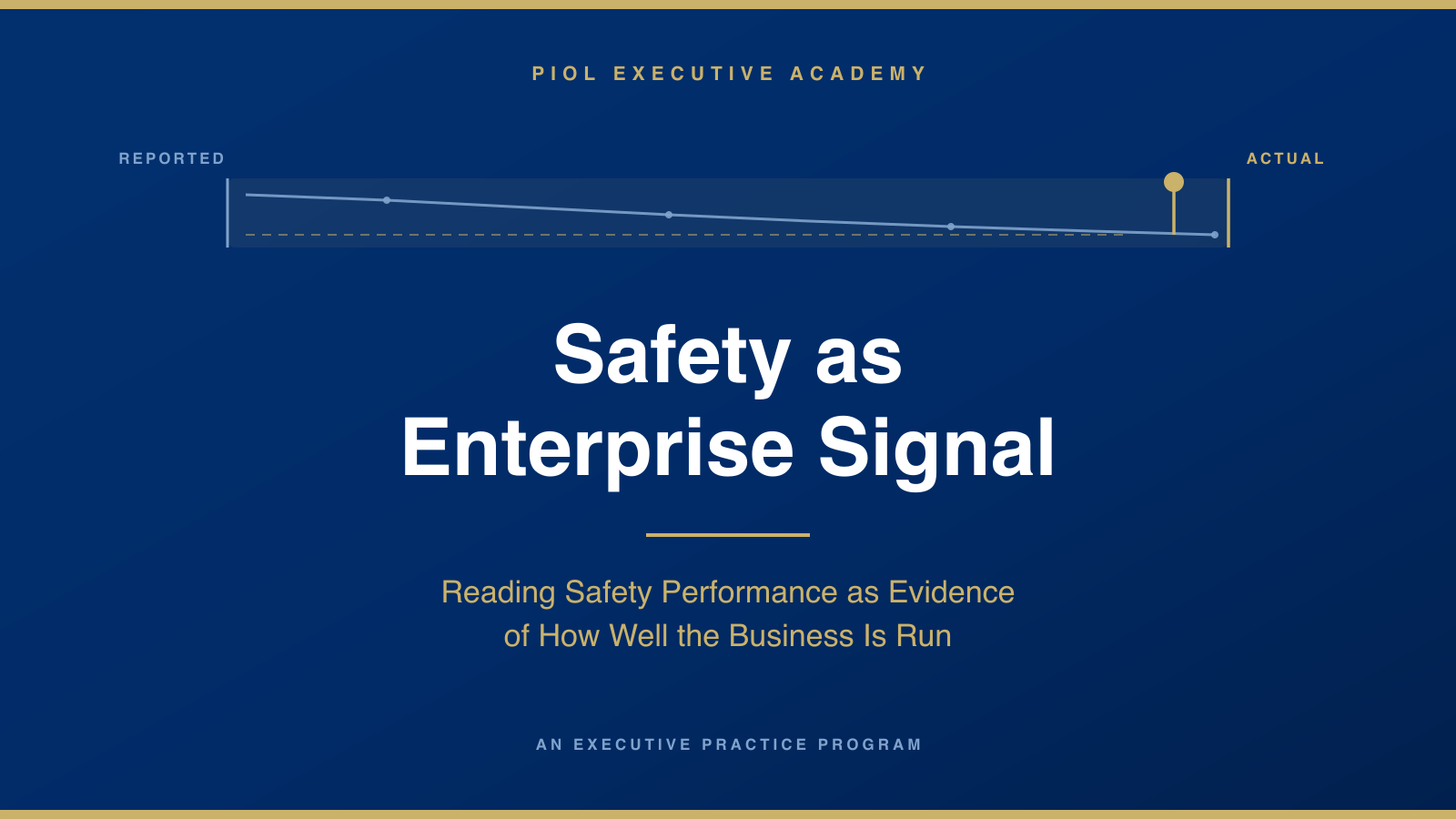
Your safety numbers are reassuring. Your exposure may not be.
Read your safety numbers as evidence about how the business is run, not as a compliance score.
Secure checkout via Stripe. Full refund within 14 days if you've completed under 10% of the course.
What you'll learn
- Explain why an organization can hold a record low injury rate in the same year it kills someone, and what each measure is actually capturing.
- Separate what a recordable rate can see from what it structurally cannot, and identify which chart your board should be receiving instead.
- Test whether a safety number describes real exposure or describes reporting behavior, before anything is concluded from it.
- Recognize the conditions that suppress a report, including the ones your own incentives and language create.
- Distinguish injury frequency from fatality potential as separate phenomena with different causes, and stop treating one as a proxy for the other.
- Identify the small number of exposures in your business capable of killing someone, and whether their controls are verified rather than assumed.
- Read a serious event backward into the operating conditions and decisions that produced it, rather than to the last person who touched the work.
- Recognize what deferred maintenance, sustained vacancy, and normalized overtime predict about coming exposure.
- Trace exposure to the upstream executive decisions that created it, in capital allocation, schedule pressure, staffing, and procurement.
- Govern the boundary where serious harm concentrates, among contractors and third parties you do not employ and cannot directly instruct.
- Price what your safety record signals to insurers, lenders, clients, regulators, and acquirers, and what a poor one costs in capital and lost work.
- Design a standing executive review that reads safety as enterprise evidence, and retire the reporting it replaces.
The problem this solves
The Most Honest Running Record You Have of Your Own Business, and Almost Nobody Reads It That Way
An organization can post its best injury rate in a decade and bury someone in the same year.
That happens often enough to be unremarkable to anyone who studies it, and it should be deeply unsettling to anyone who governs on the strength of the chart. The two facts are not in tension, because they are not measuring the same thing. Minor injury frequency responds to attention, housekeeping, supervision, and above all to whether people choose to report. Fatality responds to a small number of exposures that are usually well known, rarely eliminated, and almost never visible on the graph that reaches the board.
So the executive receives a falling line, reads it as progress, and is not wrong about the line. They are wrong about what the line describes.
This is not a safety problem. It is an evidence problem, and it is the same one senior leaders face everywhere else: a number arrives from a function, it is trusted because it is precise, and nobody has established what it is actually a measurement of. What makes safety worth an executive's attention is not that it is a moral obligation, though it is. It is that safety data is the most honest running record most organizations have of how they are actually being run.
Consider what it is generated by. Deferred maintenance. Sustained vacancy. Normalized overtime. Contractors selected on price. Capital pushed to next year. Schedule pressure applied without a stated limit. Every one of those is an executive decision, taken far from any hazard, usually for defensible reasons, and recorded faithfully in a system nobody reads as a business report. An incident is a free and unusually detailed audit of those decisions. It is almost never read as one, because the investigation stops at the last person who touched the work.
Safety as Enterprise Signal teaches senior leaders to read that record for what it discloses about the enterprise. It answers a question most executives cannot currently answer about a subject they are personally accountable for: does this number describe our exposure, or does it describe our reporting, and how would I know?
This is not a safety management course and it will not help you build a management system. It teaches nothing about hazard identification methodology, job safety analysis, or compliance clause by clause. Those belong to the function, and the function is usually better at them than you will ever be. This course is about the altitude above that: which numbers to believe, what an event is telling you about the way the business is run, which of your own decisions are creating the exposure, and how to govern the obligation through a review built for the purpose rather than through a report you receive and file.
Across eight modules you build a single connected instrument rather than a set of unrelated tools. You will separate what a recordable rate can see from what it structurally cannot, and understand why the chart shown to the board is usually the wrong one. You will test whether your own data describes exposure or reporting behavior, which is the question everything downstream depends on. You will learn why cutting minor injuries does not cut deaths, and how to find the handful of exposures in your business that can actually kill someone. You will read an incident backward into the conditions that produced it, and recognize the investigation that stops at the last person as a decision not to look further. You will trace exposure to the upstream decisions that created it, in the capital plan and the schedule and the contractor selection. You will understand where serious harm concentrates, which is among people you do not employ and cannot direct. And you will price what your record signals to insurers, lenders, clients, regulators, and acquirers, most of which executives have never seen quantified.
Two optional overlays extend the material: one for high-hazard and major accident environments, where frequency data is not merely incomplete but actively misleading, and one for multi-site and multi-jurisdiction operators, where comparing sites honestly is harder than it looks and the legal duty changes with the border.
The program is written for executives who carry the obligation rather than discharge it: chief executives and their direct reports, chief operating officers, operations and manufacturing leaders, general counsel, risk and insurance executives, board members with safety committee responsibility, and senior EHS leaders who need to argue at executive altitude rather than functional altitude. Unlike the Executive Intelligence faculty programs, this one is deliberately not function-neutral, and it uses concrete industrial examples without apology.
One thing is worth saying plainly rather than discovering in module three. This course will probably tell you that your safety performance is not as good as your numbers say. That is the common finding, it is not a reflection on your organization, and the executives who take it well are the ones who understand that a number which cannot disappoint you is a number that cannot inform you either.
The outcome is not a lower injury rate.
It is knowing what your injury rate was ever worth.
Who this is for
Three ways in
For yourself
Chief executives and operating leaders whose safety reporting is reassuring and whose exposure is not.
$695
For a cohort
EHS and L&D leaders who need the executive layer to engage with exposure rather than with rates.
Thirty minutes, no obligation, to work out whether this is the right program before you put anyone through it.
Book a callFor your company
Operating groups with contractor-heavy work, multiple sites, or a regulator who reads the same file you do.
Volume pricing, invoicing and a written proposal. Buying seats directly is on the card above.
Request a proposalRequest a proposal
Tell us roughly what you need and we will send a written proposal. You do not need an account.
The method
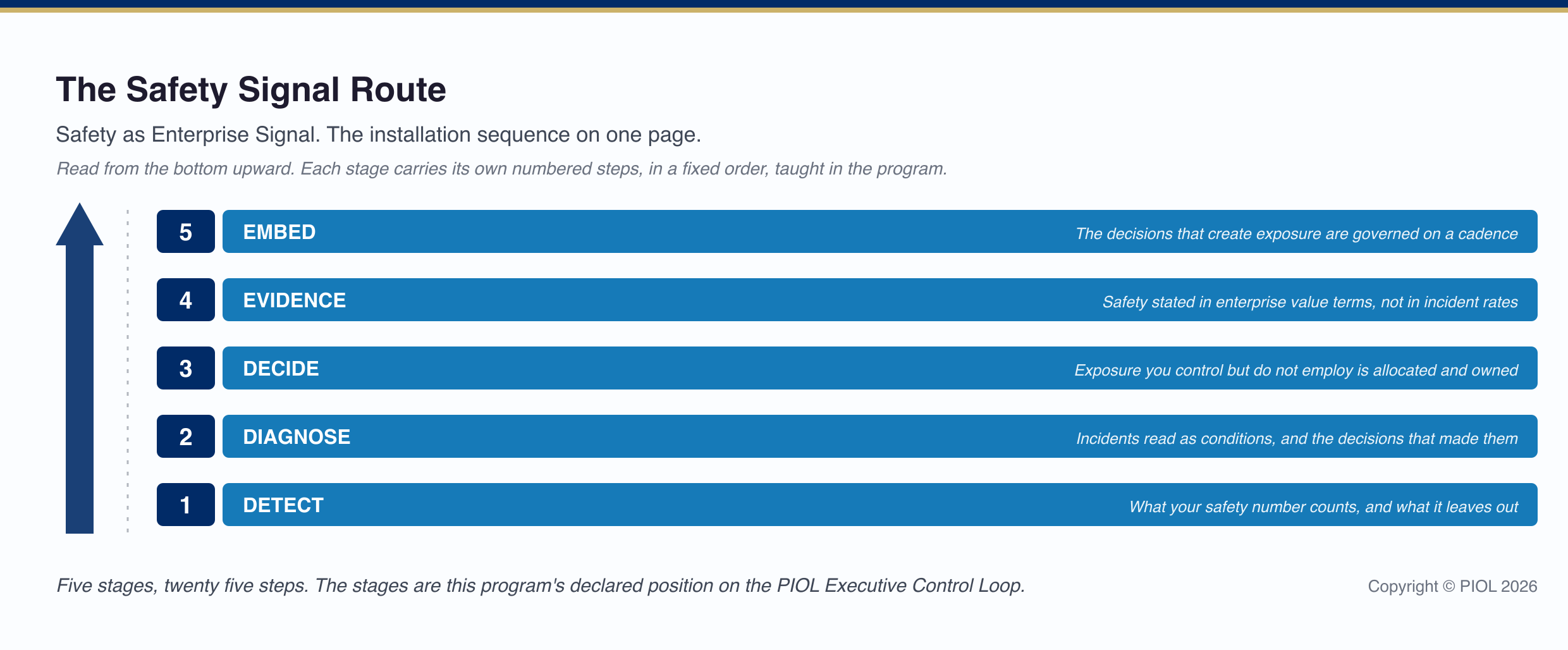
The Safety Signal Route
This program installs a method in a fixed order. Each stage carries its own numbered steps, and each step produces something you keep.
Curriculum
10 modules · 28 lessons
- The Fatality Beside the Record Low12 minPreview
- What a Recordable Rate Can and Cannot See12 min
- Why the Board Is Shown the Wrong Chart11 min
Includes: Quiz · Self-assessment · Field assignment · Worksheet
A taste: your free preview
The Fatality Beside the Record Low
An organization can post its best injury rate in a decade and bury someone in the same year. Why that is not a contradiction, what each number is actually measuring, and why the executive who trusts the falling line is not wrong about the line.
The Founding Principle: Safety performance is not a separate subject from business performance. It is the most honest running record you have of how well the business is actually being run.
Everything in this program follows from that sentence. If it is true, safety stops being a functional obligation you receive reports about and becomes a source of evidence about your own decisions, available continuously, expensive to fake, and almost universally unread.
Introduction
The site had gone four hundred and twelve days without a lost time injury.
There was a banner at the gate. The plant manager had mentioned it in the last two operations reviews, and the group chief executive had used the number in an investor session, correctly, because it was true and it was genuinely the best performance the business had recorded. The recordable rate had fallen for three consecutive years. Against every measure the organization kept, safety was improving and had been improving for some time.
In August a contractor was killed during a shutdown. He was working under a suspended load that had been rigged the way it had been rigged for years, on a job that appeared on no critical work permit because the permit system covered process isolation rather than lifting, by a crew from a firm that had been selected eleven months earlier at a rate two percent below the incumbent.
The investigation took six weeks and concluded that the rigging arrangement was inadequate and the supervisor had not intervened. Both findings were true. The supervisor was dismissed. The rigging procedure was rewritten and reissued. Within a quarter the recordable rate had resumed its fall, because a fatality is one event and the rate is a rate.
What nobody wrote down was that the organization had learned almost nothing, and that its numbers had not been wrong at any point.
Two Curves That Do Not Touch
The uncomfortable finding underneath this lesson is not that the site's data was inaccurate. It was accurate. The finding is that the falling line and the death were measuring two different phenomena that happen to share a department.
Minor injury frequency is highly responsive to management attention. Housekeeping improves, supervision tightens, hazard reporting is encouraged, personal protective equipment compliance is enforced, and the sprains and lacerations and slips that make up the overwhelming majority of recordable events decline. That is a real improvement and it is worth having. People are genuinely less often hurt.
Fatal and life-altering events do not respond to the same inputs, because they do not come from the same causes. They come from a small number of exposures that are usually well known inside the business: work at height, energy isolation, confined space, mobile plant interacting with people, suspended loads, traffic, and in process industries the loss of containment. Those exposures are not reduced by tidier walkways or better gloves. They are reduced by eliminating the exposure, or by a small number of controls that must work every single time and are therefore worth verifying rather than assuming.
So an organization can push hard on everything in the first column, watch its rate fall for three years, take entirely justified encouragement from that, and leave the second column exactly where it was. It has not been negligent and it has not been lying. It has been improving the thing it was measuring.
The Number Was Never Answering the Question
Executives receive the recordable rate as though it answers the question how safe are we? It does not answer that question and was never constructed to.
The recordable rate answers a narrower question: how often, per unit of exposure hours, did an event occur that met a defined reporting threshold? Whether that threshold is met turns on medical treatment definitions, on classification judgment, on whether someone was assigned restricted duties, and on whether the event was reported at all. Every one of those is a decision made by a person inside your organization.
That is not a criticism of the measure. It is a measure of what it measures. The error is entirely on the receiving end, where a number about reported minor events is understood as a summary of whether anyone is going to be killed.
Put the two questions side by side and the gap is obvious the moment it is stated:
- Are people being hurt in ways that meet a reporting threshold, and is that frequency falling? The recordable rate answers this well.
- Do we have exposures capable of killing someone, and are the controls on them working every time? The recordable rate is silent on this, and its silence looks exactly like a good answer.
A silent instrument that resembles a reassuring one is more dangerous than no instrument, because it occupies the space where the question would otherwise have been asked.
Why the Improvement Was Real and Still Told You Nothing
It is worth resisting the cynical reading here, because the cynical reading is wrong and will cost you credibility with the people who know the subject.
The three-year improvement at that site was not a manipulation. Nobody cooked the books. The safety team had worked hard and had genuinely reduced the number of people going home with injuries. Dismissing that as theatre is both unfair and analytically lazy, and any executive who arrives at a safety review announcing that the numbers are meaningless will find the room closes and stays closed.
The accurate statement is more precise and more useful. The improvement was real, it was in a category of harm, and it carried no information whatsoever about the category of harm that kills people. Both halves of that sentence need to survive. An executive who holds only the first half governs on a false assurance. An executive who holds only the second half discards a useful measure and demoralizes the people producing it.
What the site's leadership should have been able to say, and could not, was something like this: our frequency of minor harm is improving and we are pleased about it, and separately, here are the six exposures in this plant that could kill someone, here is what we rely on to prevent each of them, and here is how we know those controls worked last month.
Nobody could produce the second half. Nobody had been asked for it, because the first half had been arriving every month and had been accepted as the answer.
What This Costs at Executive Altitude
The consequence is not confined to safety, which is the point of this program.
Consider what the fatality actually revealed once the investigation moved past the supervisor. The lifting work sat outside the permit system, which meant the permit system had been designed around process risk and never revisited when the site's work mix changed. The contractor had been selected on a two percent rate difference, which meant contractor selection weighted price against a capability standard nobody had defined. The rigging arrangement had been in use for years, which meant that repeated exposure had been observed by many competent people and normalized by all of them.
None of those are safety findings. They are findings about design of controls, procurement judgment, and the organization's tolerance for conditions it has stopped noticing. Each of them was predictive of trouble in places that had nothing to do with lifting.
That is the argument of this course in miniature. Safety events are unusually rich evidence about the operating condition of a business, because they are generated continuously, they are documented in detail, and they are produced by exactly the decisions executives make and rarely connect to outcomes. The site's leadership had three years of a falling line and one afternoon of an investigation, and the investigation contained more information about how the business was run than the line ever did.
They filed the investigation and kept the line.
Try This Before the Next Lesson
Find the safety chart that most recently reached you or your board.
First, write down what you believed it told you before reading this lesson. Be honest and specific, in one sentence. Most executives write something close to we are getting safer.
Second, establish what it actually measures. Find the definition of the threshold behind it. Not the trend, the definition. Ask what has to happen for an event to appear in that number, and what someone must do to record it.
Third, ask the second question. Send one message to whoever owns safety in your organization asking for a list of the exposures in the business that could kill or permanently disable someone, and what is relied upon to prevent each one. Do not ask for a rate. Ask for the list.
Keep the answer, or keep the fact that there was no answer available. Both are findings, and Lesson 1.2 works from whichever you have.
Key Insight
An organization can post its best injury rate in a decade and kill someone in the same year, and this is not a contradiction because the two facts describe different phenomena that happen to share a department. Minor injury frequency responds to attention, housekeeping, supervision, and reporting encouragement, and it genuinely falls when those improve. Fatal and life-altering events come from a small number of well-known exposures that are unaffected by any of those inputs and are reduced only by elimination or by a handful of controls that must work every time. The recordable rate is an accurate answer to a narrow question about reported minor events meeting a defined threshold, and it is silent on whether anyone is going to be killed. Its silence is dangerous precisely because it resembles a reassuring answer and therefore occupies the space where the harder question would otherwise be asked.
Key Takeaways
A four hundred day run without a lost time injury and a fatality in the same year are compatible facts, and treating them as a paradox prevents the more useful reading. The improvement in minor injury frequency at that site was real, was earned, and carried no information at all about fatal exposure, and both halves of that sentence have to survive: an executive who keeps only the first governs on false assurance, and one who keeps only the second discards a useful measure and loses the room. The recordable rate answers how often reported events crossed a defined threshold, which turns on medical treatment definitions, classification judgment, and whether the event was reported at all, every one of which is a decision made by a person inside your organization. The question it does not answer is whether exposures capable of killing someone exist and whether their controls work every time, and no leadership team at that site could produce that answer because nobody had ever asked for it. What the fatality finally revealed was not primarily about lifting: it was a permit system designed for a work mix that had changed, contractor selection weighting price against an undefined capability standard, and a hazardous arrangement normalized by years of competent people looking straight at it. Those are findings about control design, procurement judgment, and organizational tolerance, and they predicted trouble well beyond safety.
PIOL Principle #1: A falling injury rate is evidence that reported minor harm is declining. It is not evidence that anyone is safe from the things that kill people, and an executive who accepts it as such has not been misled by the number. They have accepted an answer to a question they did not ask.
Want the rest of the course? Sign in or create an account, then enroll.
Ready to start?
$695 for full lifetime access. Full refund within 14 days if you've completed under 10% of the course.