Executive Practice
Quality as an Executive Responsibility
Governing Quality as Enterprise Performance Rather Than as a Function
Ask who owns quality. Then ask what they actually control.
Recognise the commercial decisions that produce quality, and start taking them knowing that.
Secure checkout via Stripe. Full refund within 14 days if you've completed under 10% of the course.
What you'll learn
- Explain why a quality function is accountable for an outcome determined almost entirely by decisions taken before it was consulted.
- Map where accountability for quality sits against where the decisions that determine it are actually taken.
- Assemble the cost of poor quality from the accounts it is scattered across, including the costs that never appear in any account at all.
- Read a specification as a commercial promise rather than a technical document, and identify the tolerance nobody costed.
- Distinguish conformance to specification from the quality a customer actually values, and recognize when the two have separated.
- Identify the point in your product and commercial cycle after which quality is being measured rather than determined.
- Judge whether you are buying supplier capability or supplier price, and what the difference costs downstream.
- Treat a launch date as a quality decision with a stated and priced consequence.
- Read a concession log as the record of executive decisions to ship what was not promised, and govern who may grant one.
- Separate a defect from an escape, and use warranty and field failure as the only customer-written report you receive.
- Recognize the revenue consequence of the customers who do not complain and simply do not return.
- Design a standing review that governs the decisions producing quality rather than the defects revealing it.
The problem this solves
You Have Been Making Quality Decisions for Years. Most of Them Were Not Labelled That Way.
Ask who owns quality in your business and the answer arrives without hesitation. Ask what that person actually controls and the answer becomes considerably less confident.
They did not write the specification. They did not select the supplier, or set the target price that narrowed the field to the ones who could meet it. They did not choose the tolerance, approve the design freeze, set the launch date, or decide whether the capital request for the machine that has to hold that tolerance was funded this year or deferred to next. On some of those they were consulted. On several they were overruled. For the rest they were not in the room.
Then the product is made, and they are accountable for whether it conforms.
This is not a failure of organizational design that a better reporting line would fix. It is the structural position of every quality function in every business that makes anything, and it explains a great deal that is otherwise puzzling. It explains why quality improvement programmes generate activity and change very little, because they are aimed at the place the problem became visible rather than the place it was created. It explains why the cost of poor quality never falls for long, because the decisions producing it are still being taken the same way by the same people. And it explains why the quality function is so often either ignored or resented: it has been cast as the department that says no to decisions it was never party to.
Quality as an Executive Responsibility makes a claim that sounds obvious and is almost never acted on. Quality is not produced by a quality function. It is the accumulated result of commercial decisions about what to promise, what to pay for, and what to accept. The quality function is where those decisions are discovered, not where they are made.
Which means the executive holding this course is not learning to supervise a department. They are learning to recognize that a set of decisions they already take, weekly, are quality decisions, and to take them knowing that.
This is not a quality management course. It teaches no statistical process control, no measurement systems analysis, no problem-solving methodology, and no standard clause by clause. Those belong to the function, and the function is better at them than you will ever be. This course is the altitude above: what quality actually costs and where that cost is hiding, why the specification is a commercial promise wearing technical clothing, which of your decisions set the ceiling on what is achievable, what a concession really is, what the customer experienced as opposed to what conformed, and what your quality position is worth commercially.
Across eight modules you build a single connected instrument. You will map where accountability for quality sits against where the decisions that determine it are actually taken. You will assemble the cost of poor quality from the accounts it is scattered across, most of which are not the quality function's, and arrive at a number that is invariably larger than anyone in the business has seen. You will examine the specification as a decision rather than a document, including the difference between conforming to what you promised and delivering what the customer values, which are not the same and are frequently not even correlated. You will find the point in your own product and commercial cycle where quality stops being determined and starts merely being measured. You will read your concession log, which is the only place in a quality system where an executive decision to ship something that does not meet what you promised is written down, and which almost no executive has ever asked to see. You will separate a defect from an escape, and learn why warranty is the only report in your business the customer wrote themselves. And you will price what your quality position is worth: the customers it qualifies you for, the premium it does or does not earn, and what an acquirer reads in it.
Two optional overlays extend the material: one for regulated and safety-critical products, where the record becomes part of the product and a quality decision is also a legal one, and one for businesses whose customers largely receive things made by somebody else.
The program is written for executives in businesses that make or specify a physical product: chief executives and their direct reports, chief operating officers, operations and manufacturing directors, engineering and technical directors, supply chain and procurement leaders, commercial directors whose promises become somebody's specification, and quality directors who need to argue at executive altitude rather than functional altitude.
One thing is worth saying at the outset. This course will probably show you that your business is paying more for poor quality than it earns from several of its product lines, and that a meaningful share of that cost was created by decisions you personally approved for entirely defensible commercial reasons. That finding is uncomfortable and it is also the good news, because a cost created by decisions can be reduced by decisions, which is not true of a cost created by bad luck.
The outcome is not a better quality department.
It is an executive who stops being surprised by their own product.
Who this is for
Three ways in
For yourself
Executives in businesses that make or specify a physical product, who own the outcome without owning the decisions.
$695
For a cohort
Quality and L&D leaders who need the argument made at executive altitude rather than functional altitude.
Thirty minutes, no obligation, to work out whether this is the right program before you put anyone through it.
Book a callFor your company
Manufacturers and regulated producers where the cost of poor quality is large, real and distributed across accounts nobody totals.
Volume pricing, invoicing and a written proposal. Buying seats directly is on the card above.
Request a proposalRequest a proposal
Tell us roughly what you need and we will send a written proposal. You do not need an account.
The method
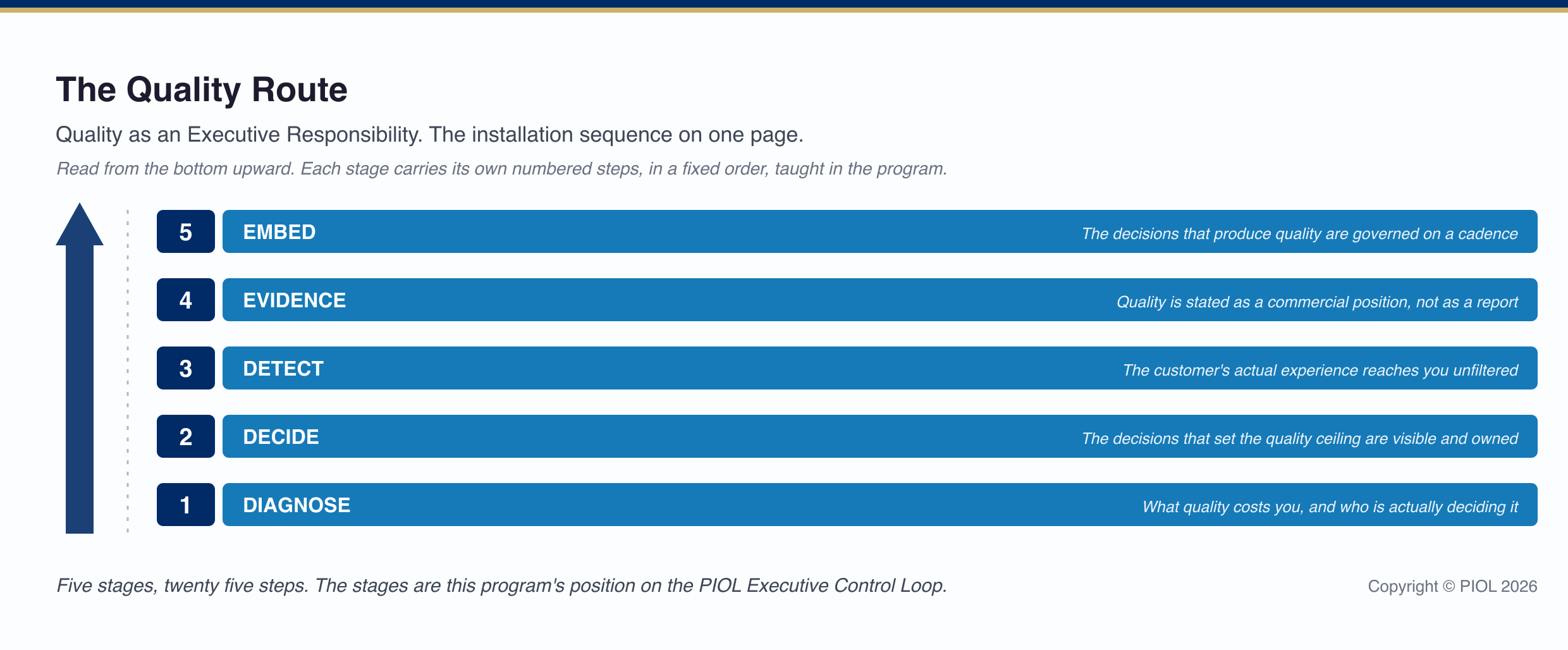
The Quality Route
This program installs a method in a fixed order. Each stage carries its own numbered steps, and each step produces something you keep.
Curriculum
10 modules · 28 lessons
- Accountability Without Authority12 minPreview
- Why Inspection Is the Visible Residue12 min
- What the Quality Report Is Not Telling You12 min
Includes: Quiz · Self-assessment · Field assignment · Worksheet
A taste: your free preview
Accountability Without Authority
The quality director is answerable for an outcome that was settled by six decisions they did not take. Why that is structural rather than a reporting-line problem, and what it explains about every quality programme you have ever funded.
The Founding Principle: Quality is not produced by a quality function. It is the accumulated result of commercial decisions about what to promise, what to pay for, and what to accept, and the quality function is where those decisions are discovered rather than made.
Everything in this program follows from that sentence. If it is true, an executive who wants better quality does not need a better quality department. They need to recognize which of their own weekly decisions are quality decisions, and take them knowing it.
Introduction
A quality director sits in a monthly operations review and presents a defect rate that has not improved in four quarters.
The chief executive, reasonably, asks what is being done about it. The quality director describes the containment actions, the additional inspection at final assembly, the supplier corrective action requests raised, and the training refreshed on the two lines where most of the failures appear. All of it is competent. None of it will work, and the quality director knows this, and has known it for two years.
The defects come from a tolerance that was set during design because it matched a competitor's published figure, on equipment that was never capable of holding it, bought at a capital budget agreed after the original request was cut by a third, from a supplier selected on price after a procurement review the quality function attended as an observer, for a launch date fixed before the process capability studies were complete.
Every one of those decisions is final. Several are irreversible without a redesign. All of them were made by people in that room, for defensible commercial reasons, and none of them was recorded as a quality decision by anybody.
Six Decisions and a Department
Take any recurring quality problem in a manufacturing business and walk it backward. The chain terminates, with remarkable consistency, in the same small set of decisions.
What we promised. The specification, the tolerance, the claimed performance. A commercial decision about what would win the order.
What we paid for. Supplier selection, material grade, the target cost that constrained both.
What we invested in. Whether the process was capable of holding what was promised, and whether the capital to make it capable was approved, deferred or cut.
Who we hired and kept. Skill, experience and turnover in the operations doing the work.
When we committed to ship. The launch or delivery date, and whether it allowed the qualification work to finish.
What we agreed to accept. The concession, the deviation, the use-as-is decision that let a nonconforming batch go.
Notice who takes each of those. Commercial. Procurement. Finance. Human resources. Engineering. The executive team. The quality function participates in some and is informed of others, and holds authority over almost none.
Then the product is made, and the department that held authority over none of it is asked to explain the result.
This Is Not a Reporting Line Problem
The natural executive response is structural: raise the quality director's reporting line, give them a veto, put them on the executive committee.
It is worth understanding why that so rarely works, because it is the standard recommendation and businesses have been trying it for forty years.
A veto over a decision you did not shape is a blunt instrument. It arrives late, it is exercised under time pressure against a commitment already made to a customer, and using it makes the quality function the reason a launch slipped. Use it once and it is respected. Use it three times and it is routed around, because an organization under commercial pressure will find a way to take the decision it needs to take, and a function that only says no will be consulted later and later until it is consulted after the fact.
The problem is not where the quality director sits. It is that the decisions determining quality are distributed across six other functions and are not recognized as quality decisions by the people taking them. You cannot fix a distributed problem with a single seat.
What This Explains
Once the diagnosis is accepted, a set of familiar frustrations stops being mysterious.
Why quality programmes produce activity and not change. They are aimed at the place the problem became visible, which is production and inspection, rather than the place it was created, which is a decision taken eleven months earlier by somebody else.
Why the cost of poor quality never falls for long. It falls while a programme runs and returns afterwards, because the decision-making that generates it was never the subject.
Why the quality function is resented. It has been structurally cast as the department that says no to commitments it was not party to, which is an unattractive role that no individual occupying it chose.
Why the same problem recurs across unrelated products. Because the recurrence is in the decision pattern, not in the product. A business that consistently selects suppliers on price and consistently defers capability capital will produce quality problems in whatever it happens to be making.
Where This Sits Against the Neighbouring Program
One boundary is worth stating plainly at the outset, because the two programs sit next to each other in the applied line and address adjacent frustrations.
Safety as Enterprise Signal makes a diagnostic claim: safety data is an unusually honest record of how a business is being run, and an executive should learn to read it. The safety record is evidence about the enterprise.
This program makes a different and stronger claim. Quality is not a record of anything. It is the direct residue of commercial decisions, which means it is not primarily something to be read but something you have been producing all along, in meetings that were not about quality.
If a passage in this course would work equally well with the word quality replaced by the word safety, it has drifted into the neighbouring program. That test is applied throughout.
Try This Before the Next Lesson
Take one recurring quality problem in your business, one that has survived at least two attempts to fix it.
Walk it backward through the six decisions. For each, establish who took it, when, and on what basis. You are not looking for fault. You are establishing where the outcome was actually settled.
Then find the date. Identify the last point at which the outcome could still have been changed without a redesign or a renegotiation. Compare that date with the date the quality function became accountable for the result.
Then ask one question of your quality director, and ask it as a genuine question rather than a challenge: which of the decisions that produce our quality problems do you have any authority over? The answer is usually short, and it is usually the first honest conversation the two of you have had on the subject.
Key Insight
A quality director presents a defect rate they cannot move, because the defects were settled by a tolerance matched to a competitor's figure, on equipment never capable of holding it, bought after a capital request was cut, from a supplier selected on price, for a launch date fixed before capability studies finished. Every one of those decisions was taken by somebody else, for defensible commercial reasons, and none was recorded as a quality decision. Six decisions recur with remarkable consistency when any quality problem is walked backward: what we promised, what we paid for, what we invested in, who we hired and kept, when we committed to ship, and what we agreed to accept. Authority over all six sits with commercial, procurement, finance, human resources, engineering and the executive team. Raising the quality director's reporting line does not fix this, because a veto over a decision you did not shape arrives late, under commercial pressure, and makes the function the reason a launch slipped, after which it is routed around.
Key Takeaways
The diagnosis explains four things that are otherwise puzzling. Quality programmes produce activity rather than change because they are aimed at where the problem became visible rather than where it was created. The cost of poor quality falls while a programme runs and returns afterwards because the decision-making generating it was never the subject. The quality function is resented because it has been structurally cast as the department that says no to commitments it was not party to, a role nobody occupying it chose. And the same problem recurring across unrelated products is evidence about a decision pattern rather than about any product, since a business that consistently buys on price and defers capability capital will produce quality problems in whatever it happens to make. The corrective is not more authority for the quality function, which has been attempted for forty years, but executives recognizing which of their own weekly decisions are quality decisions. The boundary against Safety as Enterprise Signal matters from the first lesson: that program teaches you to read a record, and this one tells you that you have been writing the outcome all along.
PIOL Principle #1: A function accountable for an outcome it has no authority to determine will produce reports, containment and inspection, because those are the only actions available to it. None of them will move the outcome, and the failure will be recorded against the function rather than against the decisions.
Want the rest of the course? Sign in or create an account, then enroll.
Ready to start?
$695 for full lifetime access. Full refund within 14 days if you've completed under 10% of the course.