Executive Practice
The Leadership Operating Model
Making Leadership Behavior Visible, Measurable, Coachable, and Governable
You can describe the behavior you want. You cannot inspect it.
Turn leadership behavior from something you describe into something you can govern.
Secure checkout via Stripe. Full refund within 14 days if you've completed under 10% of the course.
What you'll learn
- Distinguish climate from culture, and recognize which of the two you are actually looking at when you read an engagement result or hear a concern raised.
- Apply the Climate-to-Culture Conversion Test to establish whether a condition has already hardened into something the organization expects.
- Read climate as an execution signal rather than as sentiment, and detect the five operating symptoms of degraded signal integrity: delayed escalation, softened risk reporting, metrics without confidence, meetings without decisions, and undocumented workarounds.
- Audit the signals your leadership team is sending through what it inspects, rewards, ignores, questions, tolerates, escalates, and funds, and quantify what inconsistency across the team is currently costing.
- Define a leadership behavior standard of six to ten items that can be observed, coached, measured, and governed, rather than a values statement that cannot.
- Connect each behavior in the standard to the business outcome it protects across execution, risk, earnings, customer trust, and regulatory exposure.
- Defend the standard commercially to a leadership team, a board, or an investor on grounds other than aspiration.
- Embed behavioral observation into existing meetings, reviews, escalation routines, and project governance without adding bureaucracy.
- Make decision rights and escalation paths explicit enough to function as a trust mechanism, and diagnose why escalation is not currently happening.
- Measure behavior on operating evidence using the Narrative-to-Proof Ladder, building a scorecard from indicators the business already produces, and avoid the personality scoring and superficial rating traps that discredit most attempts.
- Coach behavior in operating moments rather than in episodic development conversations, and govern drift with named ownership, a fixed cadence, a real escalation path, and consequence.
- Design an intervention that changes an operating condition rather than restating an intention, and sequence it into a 90-day implementation plan.
The problem this solves
Convert Leadership Behavior From Style Into an Operating System You Can Inspect, Measure, Coach, and Govern
Almost every organization has a statement of its values, and almost none can tell you whether its leaders are living them.
That is not hypocrisy. It is a design problem. Leadership behavior is described in the language of character, style, and personality, and language of that kind cannot be inspected. You cannot audit integrity. You cannot escalate a shortfall in authenticity. You cannot coach someone toward accountability if nobody can say what accountability looks like on a Tuesday afternoon when a schedule is slipping and the honest answer is unwelcome. So behavior stays outside the operating system of the business: discussed in development conversations, mentioned at offsites, absent from every mechanism the organization actually uses to run itself.
Meanwhile the behavior is doing its work regardless. People are not waiting for the values poster. They are reading what happens: which problems get asked about twice and which get asked about once, whose bad news is received calmly and whose is punished, what gets funded after the speech about priorities, which deadline is genuinely immovable, what a leader walks past without comment. That reading is fast, accurate, and continuously updated, and it determines what people do next. The conditions a leadership team creates are built almost entirely out of these signals, and almost none of them were chosen deliberately.
The Leadership Operating Model treats those signals as the object of management. It begins with a distinction most organizations collapse: culture is what the organization has learned to repeat, while climate is what people are experiencing right now. Climate moves first, and it moves in response to leadership behavior within weeks. Read correctly, it is not sentiment. It is signal integrity, and its degradation shows up in places an executive already looks: escalation arriving later than it should, risk reporting that has been softened on the way up, metrics nobody quite believes, meetings that produce discussion rather than decisions, work that quietly routes around the official process.
From that diagnosis the program builds the model itself. You define a behavior standard specific enough to be observed rather than admired. You connect each behavior to the business result it protects, so the standard survives contact with a leadership team that wants to know why this matters commercially. You embed observation into the cadence that already exists rather than adding a new layer of process. You make decision rights and escalation paths explicit, because people do not raise problems when the route is unclear, when they expect to be blamed, or when they have learned that nothing happens. You replace personality rating with indicators drawn from operating evidence the business already produces: decision closure, escalation timing, the quality of action closure, the recurrence of issues that were supposedly resolved. And you install coaching close to the work, governance with real ownership and real consequence for drift, and an intervention designed to change an operating condition rather than to communicate a better intention.
Across eight modules these assemble into your Leadership Operating Model package: a behavior standard, a behavior-to-outcome map, a visibility audit, a behavior scorecard, a decision rights and escalation map, a coaching cadence, a governance review template, and a 90-day implementation plan for the part of the business you are accountable for. Two optional overlays extend the core: one for regulated and high-stakes environments, where behavior determines whether evidence is trustworthy and whether the organization is genuinely in control or merely documented, and one for scaling the standard across sites, functions, and growth stages.
This program works at the leader's own span of control: the conditions your leadership team creates and the behavior it can install. Diagnosing an entire enterprise, and separating signal from noise across a whole business, is the work of Executive Organizational Intelligence™. Designing governance as an institution is the work of Executive Governance Intelligence™. Where this program meets either, it points to them rather than borrowing their material.
The outcome is not a more inspiring set of values.
It is leadership behavior that can be seen, measured, coached, and governed like anything else the business depends on.
Who this is for
Three ways in
For yourself
Executives who own a culture or engagement problem and have found that values language does not move it.
$695
For a cohort
HR and L&D directors who need a behavior standard that survives contact with a performance conversation.
Thirty minutes, no obligation, to work out whether this is the right program before you put anyone through it.
Book a callFor your company
Companies rolling a leadership standard across sites or functions, where consistency is the whole difficulty.
Volume pricing, invoicing and a written proposal. Buying seats directly is on the card above.
Request a proposalRequest a proposal
Tell us roughly what you need and we will send a written proposal. You do not need an account.
The method
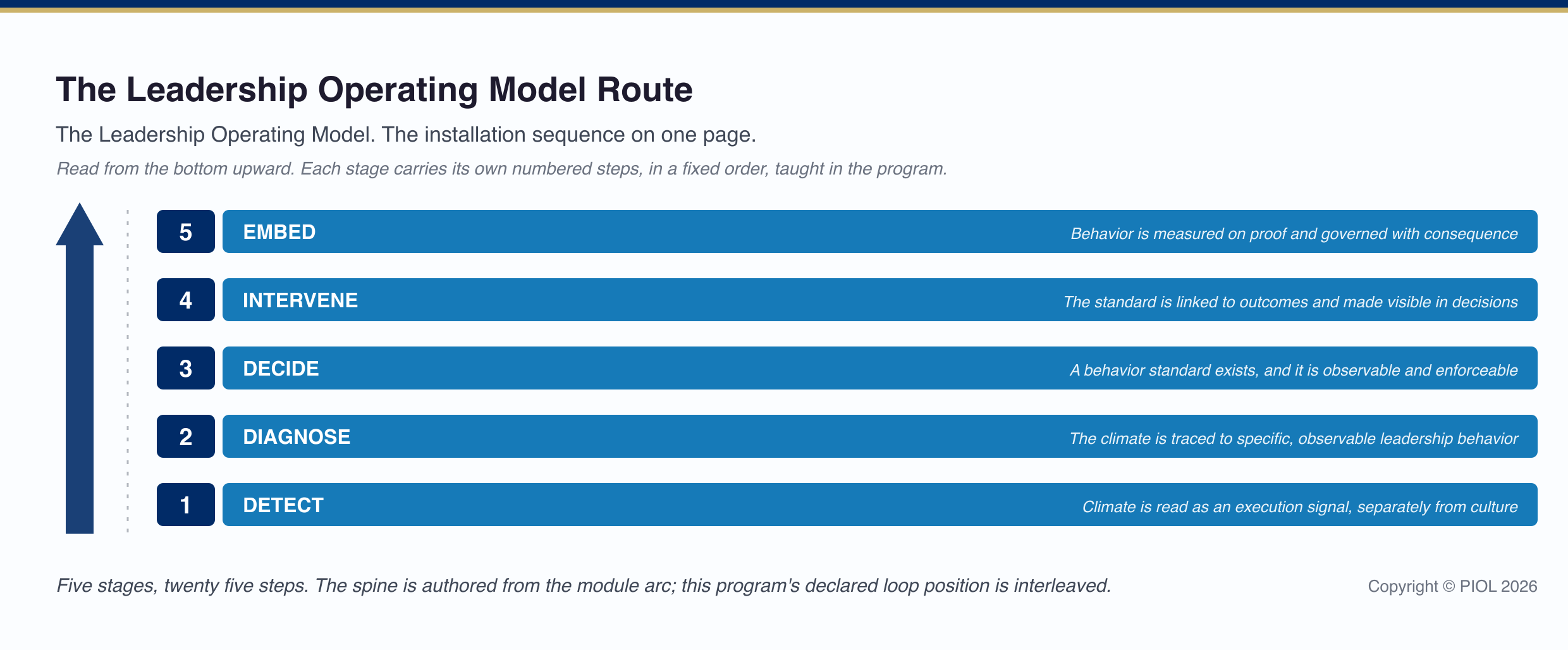
The Leadership Operating Model Route
This program installs a method in a fixed order. Each stage carries its own numbered steps, and each step produces something you keep.
Curriculum
10 modules · 28 lessons
- What People Are Experiencing Right Now10 minPreview
- The Climate-to-Culture Conversion Test10 min
- Why Leaders Are the Last to Know10 min
Includes: Quiz · Self-assessment · Field assignment · Worksheet
A taste: your free preview
What People Are Experiencing Right Now
Culture is what the organization has learned to repeat. Climate is what people are experiencing today, it moves first, and it is the only one of the two that leadership behavior can reach this quarter.
The Founding Principle: An organization does not respond to what its leaders say they value. It responds to what leaders inspect, reward, tolerate, escalate, and fund.
Everything in this program follows from that sentence. If it is true, leadership behavior is not a matter of character to be admired or coached in private. It is the mechanism through which an organization is actually operated, and mechanisms can be defined, made visible, measured, and governed.
Introduction
Consider two documents that describe the same organization in the same month.
The first is the annual culture and engagement report. It is professionally produced, benchmarked against a comparator set, and broadly encouraging. Scores are stable. A few themes recur. The leadership team discusses it for forty minutes, notes two areas for attention, and commissions a working group.
The second document does not exist in written form. It is what an experienced person in that organization would tell you over a drink, off the record, if they trusted you: which meeting is worth preparing for and which is theatre, whose bad news gets received calmly and whose gets punished, which deadline is real, what the last reorganization actually taught everyone about how decisions get made, and what they personally would never put in writing.
Both documents are accurate. They are describing different things. The first describes culture, which is what the organization has learned to repeat over years. The second describes climate, which is what people are experiencing right now, and which was materially different eight weeks ago.
Most leadership teams have access only to the first, discuss it annually, and act on it slowly. The second is the one currently determining what gets escalated, what gets attempted, and what gets quietly withheld.
Two Different Questions
The two words are used interchangeably in most executive conversation, and the substitution is expensive, because they answer different questions.
Culture answers: what has this organization learned to repeat? It is accumulated. It is built from thousands of prior instances in which something was rewarded or punished, escalated or ignored, funded or declined. It is durable by definition, since anything that did not persist did not become culture. It is also genuinely slow to move, which is why culture programs are measured in years and why so few of them can demonstrate an effect.
Climate answers: what are people experiencing here now, and what are they doing about it? It is current. It is built from recent instances, weighted heavily toward the most recent. It is specific to a location, a function, and often to a single leader. Two sites of the same company, sharing one culture, can run entirely different climates, and the difference will usually trace to the behavior of a small number of people.
The borrowed meteorological metaphor is worth setting aside, because it inverts the important relationship. In the natural world, climate is the slow variable and weather is the fast one. In an organization the reverse holds. Climate is the fast variable, responsive to leadership behavior within weeks. Culture is the slow one, and it is largely made of climate that was allowed to persist.
Culture is not the cause of climate. It is the residue of climate that nobody interrupted.
That inversion is the practical opening. If culture were the primary object, an executive would be working on a variable with a multi-year response time and no reliable instrumentation. Climate is the primary object precisely because it moves, because it moves in response to things a leadership team controls, and because it can be read now rather than surveyed next year.
Climate Moves First
The speed is easy to underestimate until it is observed directly.
A senior leader receives an unwelcome piece of news in a Tuesday review and responds by questioning the competence of the person who raised it. That single event is discussed in perhaps a dozen conversations within two days. Within a week, three people who had been preparing to raise something similar have revised their plan, and one has decided to wait for more certainty before saying anything. Nothing has been announced. No policy has changed. The organization's willingness to surface early, uncertain, incomplete information has just measurably decreased, and the leader who caused it has no idea it happened.
Run the same mechanism in the other direction. A leader receives equally unwelcome news, thanks the person for the timing rather than the content, asks what would help, and follows up unprompted the following week. The same dozen conversations occur, with the opposite conclusion.
Neither of these is a culture event. Both are climate events, and their effect is fast, local, and cumulative. Repeat either one consistently for eighteen months and you have produced culture, at which point it becomes extremely difficult to reverse, because the organization has now learned it rather than merely observed it.
This is the entire logic of the program. Behavior produces climate in weeks. Climate produces culture in years. The intervention point is behavior, and the measurable variable is climate.
Why the Distinction Is Not Academic
Confusing the two produces two specific and common failures.
The first is treating a climate problem as a culture problem. A leadership team detects a condition, defensiveness in reporting, or reluctance to escalate, and responds with a program: values refreshed, communication improved, training commissioned. The program is well built and well received. Eighteen months later the condition is unchanged, because the condition is being regenerated weekly by leadership behavior the program never touched. Every organization that has run a culture initiative alongside an unmodified leadership team has produced this result.
The second is treating a culture problem as a climate problem. A leadership team detects the same condition, correctly identifies a behavior driving it, corrects that behavior, and expects the condition to lift. It does not, or it lifts far more slowly than the effort seems to justify, because the condition has been in place long enough that the organization has adapted around it. People have built workarounds, adjusted expectations, and reorganized their working lives on the assumption that it will not change. Correcting the behavior is necessary but no longer sufficient, and a leadership team that expected a quick response reads the delay as evidence that the intervention failed.
Distinguishing the two is therefore not a definitional nicety. It determines whether you are intervening on a condition that will respond in one quarter or one that has hardened and requires something more deliberate. The test that separates them is the subject of the next lesson.
Where This Program Sits
Two boundaries are worth stating now, because they define what this course will and will not do.
This program works at your own span of control. The conditions your leadership team creates and the behavior it can install. It does not teach enterprise-wide organizational diagnosis, reading signal from noise across an entire business, which is the subject of Executive Organizational Intelligence™. It does not teach the design of governance as an institution, which is the subject of Executive Governance Intelligence™. Where the material reaches those boundaries, it will say so and point you there rather than teaching a compressed version.
This program runs the house method. Every PIOL Executive Academy program follows the same six-step loop, and naming it here means you will recognize it rather than meet it unannounced:
The PIOL Executive Control Loop: Detect, Diagnose, Decide, Intervene, Evidence, Embed.
Modules 1 and 2 are Detect. Module 3 is Diagnose. Modules 4 and 6 are Decide. Module 7 is Evidence. Module 8 is Intervene and Embed. The loop is the discipline; leadership behavior is the domain this program applies it to.
Executive Reflection
There is a reason this distinction is uncomfortable rather than merely useful.
If climate is fast, local, and driven by leadership behavior, then the conditions in the part of the business you run are substantially your product. Not your inheritance, not your predecessor's, not the sector's, and not the organization's culture. Yours, refreshed weekly, by decisions you are making without registering them as decisions.
Most executives accept this in principle and resist it in practice, and the resistance is understandable, because the alternative framing is more comfortable and always available. Culture is a plausible explanation for almost any condition, and it has the useful property of being nobody's specific responsibility. It absorbs findings without requiring action from any individual.
The test of whether you have actually accepted the distinction is not whether you agree with it. It is whether, on encountering a condition you dislike in your own organization, your first question is what the culture is doing or what you did last month.
Executive Exercise: The Two Column Read
Take one condition in your part of the business that you would change if you could. Something behavioral rather than technical: problems arriving late, disagreement not surfacing in the room, decisions reopening after they were made, initiative concentrated in too few people.
Write it at the top of a page. Then fill two columns.
Column one: the culture account. What is the accumulated, historical, organization-level explanation for this condition? What has this organization learned to repeat, and over how long? Be genuinely fair to this account rather than writing a straw version of it.
Column two: the climate account. What has happened in the last ninety days, in this specific part of the business, that would produce or sustain this condition? Restrict yourself to observable events: specific meetings, specific responses to specific news, specific things that were funded or declined, specific things that were walked past. Name at least five.
Two findings usually emerge. The first is that column two is harder to write, not because there is less material but because it requires recalling your own conduct rather than describing a system. The second is that column two contains items you had not previously connected to the condition at all.
Then answer one question: of the items in column two, how many were decisions you would defend if the whole organization could see them side by side?
Keep both columns. Lesson 1.2 gives you the test for which account is actually governing.
Key Insight
Culture and climate are not two words for the same thing at different resolutions. Culture is what the organization has learned to repeat, accumulated over years and slow to move. Climate is what people are experiencing now, driven by recent leadership behavior, local to a leader and a place, and responsive within weeks. The relationship runs one way: behavior produces climate, and climate that nobody interrupts eventually becomes culture. That makes behavior the intervention point and climate the measurable variable, and it makes the conditions in your part of the business substantially your current product rather than your inheritance.
Key Takeaways
The two documents that describe any organization, the annual engagement report and the off-the-record account an experienced insider would give, are both accurate and describe different variables. Executives generally have access only to the first, which reports the slow variable, while the fast variable is the one determining what gets escalated and attempted this week. Climate responds to single leadership events within days and spreads through conversation rather than announcement, which is why a leader can materially reduce their organization's willingness to report early without ever knowing they did it. Confusing the two variables produces two predictable failures: a culture program that cannot succeed because leadership behavior keeps regenerating the condition it addresses, and a corrected behavior that appears not to work because the condition has been in place long enough for the organization to have adapted around it. The program that follows works at your own span of control, cites the faculty programs at the enterprise and governance boundaries rather than teaching their material, and runs the PIOL Executive Control Loop as its method.
PIOL Principle #1: Culture is what the organization has learned to repeat; climate is what it is experiencing now. Only one of the two is still moving, and it is the only one your behavior can reach this quarter.
Want the rest of the course? Sign in or create an account, then enroll.
Ready to start?
$695 for full lifetime access. Full refund within 14 days if you've completed under 10% of the course.