Executive Intelligence™
Executive Organizational Intelligence™
Separating Signal from Noise Before Making High-Consequence Decisions
You are accountable for far more than you can personally see.
Tell what is actually happening in your organization, before the decision that depends on it.
Secure checkout via Stripe. Full refund within 14 days if you've completed under 10% of the course.
What you'll learn
- Understand why the first ninety days of executive leadership represent the highest period of organizational and personal risk.
- Build a structured executive observation model that separates facts, assumptions, and organizational narratives.
- Distinguish meaningful organizational signals from operational noise.
- Analyze how information flows through formal and informal organizational systems.
- Identify where critical information becomes delayed, filtered, distorted, or suppressed.
- Recognize hidden organizational dynamics that influence execution and decision-making.
- Design governance systems that improve organizational intelligence rather than simply increase reporting.
- Build executive review structures that focus on decision quality instead of meeting activity.
- Diagnose operational friction and distinguish between healthy tension and systemic dysfunction.
- Identify silent indicators of quality, operational, financial, regulatory, and cultural risk before they become visible failures.
- Evaluate dashboards, KPIs, and executive reports using evidence-based validation techniques.
The problem this solves
Master the Art of Reading Organizations Before Leading Change
Every organization generates signals.
Some are visible in dashboards, financial reports, customer complaints, audit findings, employee turnover, or operational performance. Others are hidden beneath the surface, in informal conversations, delayed decisions, recurring exceptions, political dynamics, governance failures, and the subtle patterns that reveal how an organization truly operates.
The challenge for executive leaders is not a lack of information. It is distinguishing meaningful signals from the overwhelming amount of organizational noise.
Many executives enter a new role believing they have been hired to make decisions quickly. In reality, they have been hired to make the right decisions. Those decisions depend on accurately interpreting the organization before attempting to transform it.
The first ninety days of executive leadership are often the most dangerous period in an executive's tenure. Leaders inherit existing narratives, polished dashboards, conflicting opinions, and pressure to deliver immediate results. Without a disciplined approach to organizational diagnosis, they risk solving the wrong problems, reinforcing ineffective systems, or creating unintended consequences that take years to correct.
Reading Signal vs. Noise in Executive Leadership is a practical executive development program that teaches leaders how to observe organizations systematically, evaluate evidence objectively, interpret operational signals accurately, and make high-quality decisions under uncertainty.
Rather than focusing on generic leadership theories or motivational concepts, this course provides a practical operating methodology used to understand enterprise performance before initiating change.
Throughout ten comprehensive modules, you will learn how organizations communicate, where information becomes distorted, how governance influences decision quality, and why informal power structures often have greater impact than formal organizational charts. You will develop the ability to recognize weak signals before they become major business problems, identify systemic causes instead of isolated symptoms, and build governance systems that continuously improve organizational awareness.
This program introduces proprietary PIOL Executive Frameworks that can be immediately applied within your own organization. Every module includes practical tools, executive worksheets, diagnostic templates, reflection exercises, case studies, and implementation guidance designed for senior leaders responsible for strategy execution, operational performance, governance, quality, risk, and organizational transformation.
By the conclusion of the program, you will have developed your own Executive Signal Operating System, a structured approach for continuously sensing organizational conditions, validating evidence, making better decisions, and leading with greater confidence.
This is not simply another leadership course.
It is an executive operating methodology for leaders who must make high-consequence decisions with incomplete information.
The Founding Principle: The quality of executive decisions is limited by the quality of executive diagnosis.
Every principle that follows in this programme is a way of raising the quality of your diagnosis. This is the conviction the whole course rests on: an executive cannot decide better than they can see.
Who this is for
Three ways in
For yourself
A chief executive or direct report in an organization too complex to observe personally, most often within the first ninety days of a new role.
$995
For a cohort
Heads of L&D and people functions putting a newly appointed leadership group through a common diagnostic language.
Thirty minutes, no obligation, to work out whether this is the right program before you put anyone through it.
Book a callFor your company
Boards and executive teams who want one shared reading of the organization rather than five private ones.
Volume pricing, invoicing and a written proposal. Buying seats directly is on the card above.
Request a proposalRequest a proposal
Tell us roughly what you need and we will send a written proposal. You do not need an account.
The method
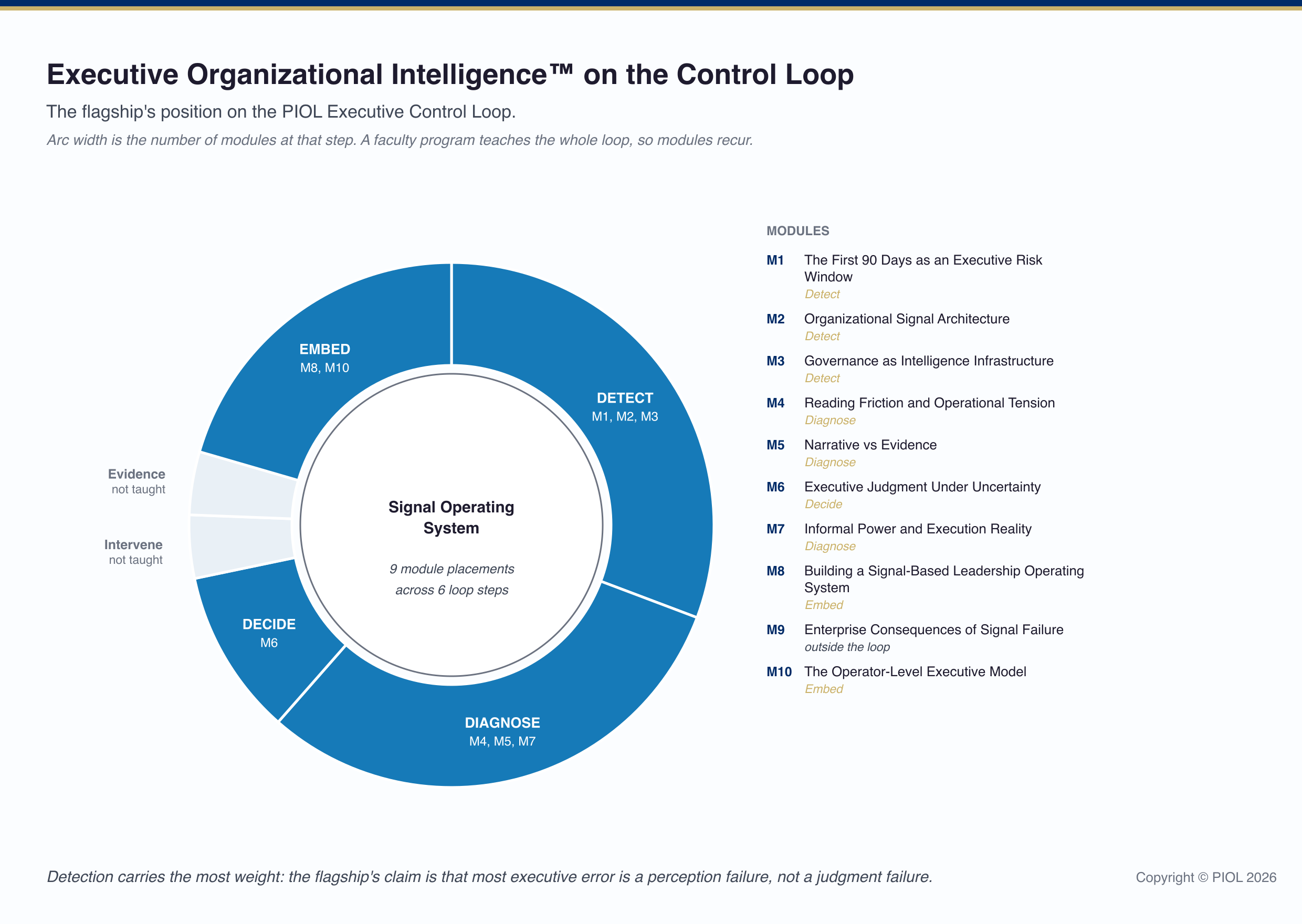
Executive Organizational Intelligence™ on the Control Loop
A faculty program teaches the whole executive control loop rather than a sequence, so its modules return to the same steps from different angles. The width of each arc is how much of the program sits there.
Curriculum
10 modules · 30 lessons
Why the First 90 Days Determine Whether You Lead the Organization or the Organization Leads You. Your authority peaks before your understanding does. Early decisions are the most leveraged and the least informed you will ever make. This module converts onboarding from relationship-building into disciplined intelligence collection, and leaves you owning a Personal Observation Model: the baseline against which every future signal is measured.
- Transition Risk: Why Authority Arrives Before Understanding9 minPreview
- Organizational Conditioning: How the System Shapes What You Are Allowed to See8 min
- From Impression to Evidence: Interpreting Signal and Building Your Observation Model9 min
Includes: Quiz · Self-assessment · Field assignment · Worksheet
A taste: your free preview
Transition Risk: Why Authority Arrives Before Understanding
Why your first decisions are the riskiest you will make, and the one question that keeps an early move from becoming an expensive, irreversible mistake.
Introduction
Every executive inherits authority before they inherit understanding.
On the first day, the mandate is already complete. The title carries the power to reorganise, to reallocate, to promote and remove, to redirect strategy. What the title does not carry is knowledge of the system those powers act upon. The organization has been running for years without the new leader, and it will continue to run according to its own logic regardless of how quickly that leader wishes to understand it.
This produces the defining hazard of any senior transition. Authority peaks early. Understanding accumulates slowly. The two curves do not meet for months, and the gap between them is precisely the period in which the most consequential early decisions are made.
NOTE: _For a senior executive (VP, COO, CFO, CEO)
The average timeline is approximately: 30 days: 15-25% understanding 90 days: 35-50% 180 days: 60-75% 9 months: 75-85% 12 months: 85-90%
This means reaching roughly 90% understanding typically takes between 9 and 12 months in a stable organization.
Why it takes so long The last 40% of understanding is not about learning facts. It comes from observing repeated business cycles:
- monthly operating reviews
- quarterly financial results
- budgeting
- hiring and performance decisions
- customer escalations
- supplier issues
- strategy execution
- organizational reactions under pressure
Until an executive has experienced several of these cycles, they are often seeing isolated events rather than recurring patterns._
An executive is rarely given the luxury of waiting for those curves to converge. Boards expect early signs of grip. Teams look for direction within weeks. Peers begin forming judgements almost immediately. So the new leader acts, and every early action is taken with the most authority and the least information they will ever simultaneously possess.
The tension is unavoidable. The cost of being wrong is front-loaded. An error made in month two is made with sweeping authority and thin understanding, and it is frequently an error that cannot easily be undone.
The Front-Loaded Cost of Error
Most leaders instinctively picture risk as something that grows over time: the longer you lead, the larger the decisions, the greater the exposure. In a transition, the opposite is true. The riskiest decisions are often the earliest ones, for three reasons.
The first is leverage without calibration. Early decisions are read as signals. They reset norms, establish priorities, and tell the organization what the new leader values. A single early move teaches the organization more about you than a year of stated intentions, yet it is made before you understand what the organization will read into it.
The second is irreversibility. Restructures, departures, cancelled initiatives, and public reversals of a predecessor's decisions are expensive to undo, not merely operationally but in credibility. An early irreversible move made on a misreading cannot be quietly corrected; it has already reshaped the system.
The third is anchoring. The earliest conclusions become the lens through which all subsequent information is interpreted. Once formed, that lens is remarkably resistant to contradiction. Later evidence gets bent to fit the first impression, and disconfirming signals are dismissed as exceptions.
The greatest early risk is not making a difficult decision. It is making the right decision for the wrong diagnosis, with enough authority to make it stick.
The Seduction of the Decisive First Win
The most common expression of transition risk is the decisive first win, a visible early action chosen partly for its optics. Stakeholders reward apparent momentum, so the temptation is to reach for actions that are legible from the outside: a structure redesign, a high-profile leadership change, a new strategic priority announced early, a transformation programme launched within the first quarter.
None of these are wrong in themselves. The question is whether they respond to a verified condition of the organization, or merely satisfy the expectation that something should be seen to happen.
Consider a newly appointed commercial leader who, three weeks in, restructures the sales territories to signal decisiveness. Externally it reads as a bold and welcome first win. Two quarters later it becomes clear that the previous design quietly encoded years of hard-won account relationships, relationships that appeared nowhere on any chart. The "inefficiency" that was removed had been load-bearing. The move was both highly visible and, as it turned out, wrong: taken with full authority and almost no understanding, and expensive to reverse.
Visible activity is easily mistaken for decisive leadership. It is not the same thing. An executive who defers major interventions while evidence accumulates may appear less active in the opening months and yet produce markedly better outcomes across the years that follow. Patience, in leadership, is routinely misread as hesitation. It is more often the discipline required to prevent unnecessary and irreversible change.
The Governing Question: Reversibility
If the danger of the transition window is irreversible action on thin understanding, the discipline that answers it is to treat reversibility as the first question asked of any early decision.
Before acting, place each intended move against two dimensions. The first is reversibility: could this be undone cheaply, within roughly thirty days, if it proved mistaken? A decision is reversible (a probe you can withdraw), sticky (undoable but at real cost), or irreversible (a one-way door). The second is signal confidence: how well corroborated is the understanding this decision rests upon? A single strong impression, or several independent signals pointing the same way?
The governing rule of the first ninety days follows directly:
Irreversible decisions made on weak or moderate confidence should be deferred. Spend the transition window on reversible probes; reserve one-way doors for when understanding has caught up with authority.
This does not counsel inaction. Reversible decisions can and should be made quickly, even on limited evidence, precisely because the cost of being wrong is a cheap correction. The discipline applies only where the two dangerous properties combine: high irreversibility and low confidence. That combination is where transition failures are made, and it is almost always avoidable.
Executive Reflection
During a transition, the organization is not only being observed. It is observing the observer. The moves you make early teach people what you value and what they can expect. A rapid, visible intervention signals that momentum matters to you, and the organization will begin performing momentum in return. A deferred decision paired with sharp questions signals that you intend to understand before you act, and the organization will begin surfacing the evidence you are clearly weighing.
For this reason the opening months are best characterised less by the appearance of certainty than by disciplined restraint. Confidence has its place. In a transition, the more valuable posture is the visible willingness to wait for understanding before spending irreversible authority.
Executive Exercise: The Reversibility Ledger
List every action you intend to take, or feel pressure to take, in your first ninety days. For each, record two judgements:
- Reversibility. Mark it Reversible, Sticky, or Irreversible. Ask honestly: could I undo this within thirty days at acceptable cost?
- Signal confidence. Rate the understanding it rests on from 1 (a single impression or inherited assumption) to 5 (multiple independent, corroborated signals) using the PIOL Confidence Scale.
Then apply the rule of the window:
- Irreversible × confidence 1 to 3 → defer. One-way doors on thin evidence. Move them past the observation window and convert them, where possible, into reversible probes (a pilot in one region rather than a full redesign).
- Reversible × any confidence → act. Cheap to correct; deciding quickly here builds legitimate momentum.
- Sticky × confidence 1 to 3 → stage. Break into reversible steps, or gather one more corroborating signal first.
The purpose is not to slow you down. It is to ensure the authority you spend early is spent on decisions you can afford to get wrong, and that the decisions you cannot take back wait for the understanding they deserve.
Key Insight
In a transition, risk is not distributed evenly across your tenure. It is concentrated at the beginning, in the gap between the authority you already hold and the understanding you have not yet earned. The executives who navigate that gap well are not the ones who move fastest or slowest. They are the ones who match the reversibility of each early decision to the confidence behind it.
Key Takeaways
Executive transitions are dangerous because authority arrives complete on day one while understanding accumulates over months, and the most consequential early decisions are therefore made at the point of maximum power and minimum knowledge. The characteristic failure is the decisive first win, a visible move chosen for its optics that rests on a misreading of a system the leader does not yet understand. The discipline that answers this is reversibility: act quickly where a decision can be cheaply undone, and defer the irreversible until confidence has caught up with authority. Restraint, in the transition window, is not hesitation; it is the deliberate protection of decisions you cannot take back.
PIOL Principle #1: In a transition, spend your authority where you can afford to be wrong, and defer every irreversible decision until your understanding has caught up with your power.
Want the rest of the course? Sign in or create an account, then enroll.
Ready to start?
$995 for full lifetime access. Full refund within 14 days if you've completed under 10% of the course.