Executive Intelligence™
Executive Operational Intelligence™
Seeing the Enterprise as an Integrated System
Every site passes its own inspection. The enterprise still cannot prove control.
See the enterprise as one system, so control holds across it rather than site by site.
Secure checkout via Stripe. Full refund within 14 days if you've completed under 10% of the course.
What you'll learn
- Diagnose where an enterprise behaves as a federation of local systems rather than as one integrated business.
- Distinguish certification, compliance, readiness, and control, and recognize which of them your current evidence actually demonstrates.
- Identify the hidden cost of local interpretation, where the same requirement quietly carries a different meaning in each part of the business.
- Define the enterprise control spine: the non-negotiable controls every part must follow, without over-standardizing what should remain local.
- Separate enterprise, sector, and site-level requirements so that standardization does not force every part of the business to operate identically.
- Assign explicit decision rights for standards, execution, exceptions, escalation, and effectiveness verification.
- Design a system that survives the departure of the individuals currently holding it together.
- Build evidence traceability that connects a requirement to its control, its owner, its record, its review, and its proof of effectiveness.
- Prove control on demand without manual reconstruction, and recognize where weak evidence is creating exposure you cannot yet see.
- Distinguish approved local variation from inherited variation, and govern adaptation without permitting drift.
- Redesign a recurring management review from a reporting ritual into a decision and escalation forum.
- Sequence an enterprise control program so that it delivers visible movement without attempting everything at once.
The problem this solves
Build the Control Architecture That Makes an Enterprise Legible to the People Accountable for It
Most enterprises do not lack procedures.
They have procedures in abundance. Every site, region, function, and business unit has its own way of defining a problem, recording a decision, escalating a risk, and proving that something was done. Each of those ways may be perfectly sound in isolation. Every part can pass its own inspection, satisfy its own auditor, and report a clean quarter.
And yet the enterprise as a whole cannot say what it controls.
It cannot compare one part to another, because the parts measure different things and call them the same name. It cannot see a problem spreading, because each occurrence is logged locally as an isolated event. It cannot produce proof on demand, because proof has to be reconstructed by hand every time someone asks. Leaders in this position are not uninformed. They are informed in fragments, and fragments cannot be added together.
This is the condition that quietly limits how large and how complex a business can safely become. Growth adds parts faster than it adds connective tissue. Acquisition imports whole systems built on other assumptions. Decentralization, which was the right answer to a real problem, gradually converts one enterprise into a federation of well-run islands. Nothing fails visibly. Control simply stops scaling, and the first evidence usually arrives from outside: a customer audit, a regulatory finding, a diligence process, a failure that had already happened three times elsewhere in the business without anyone connecting them.
Executive Operational Intelligence™ teaches senior leaders to see the enterprise as one system rather than a collection of parts that each look healthy. It answers a question every executive with multi-unit accountability eventually faces: where does control actually live in this business, where does it fragment, and how would I know before someone outside tells me?
This is not a course about documentation, certification, or compliance administration. Those are downstream effects. The subject is the architecture underneath them: what must be common across the enterprise and what must not, who holds which decision, how evidence connects a requirement to its proof, how local adaptation is permitted without becoming uncontrolled drift, and how a recurring review stops being a presentation and becomes the mechanism that holds the parts together.
Across eight modules you will build a single connected artifact rather than a set of unrelated tools. Each module contributes one part of the Enterprise Control Model: the control spine, the requirement layers, the decision rights, the evidence traceability, the variation governance, and the review cadence. By the final module these assemble into your own Multi-Site Control Architecture, a practical operating design for the business you are actually accountable for, with a 90-day roadmap for putting it in place.
The program is built for executives who carry enterprise-level accountability across parts they do not personally run. It is sharpest in businesses that are multi-site, multi-sector, recently acquisitive, or operating under external scrutiny, and it applies equally to manufacturing, service, distribution, and professional-services organizations. Two optional overlays extend the core for leaders who need them: one mapping the architecture across formal management system standards, and one preparing it for board, customer, regulator, and acquirer examination.
The outcome is not more documentation.
It is control that scales.
Who this is for
Three ways in
For yourself
Chief operating officers and operations directors accountable for performance across sites that each pass their own inspection.
$995
For a cohort
L&D and operational excellence leaders standardising how the group talks about control, evidence and variation.
Thirty minutes, no obligation, to work out whether this is the right program before you put anyone through it.
Book a callFor your company
Multi-site and multi-business groups that cannot currently compare their parts or prove control at enterprise level.
Volume pricing, invoicing and a written proposal. Buying seats directly is on the card above.
Request a proposalRequest a proposal
Tell us roughly what you need and we will send a written proposal. You do not need an account.
The method
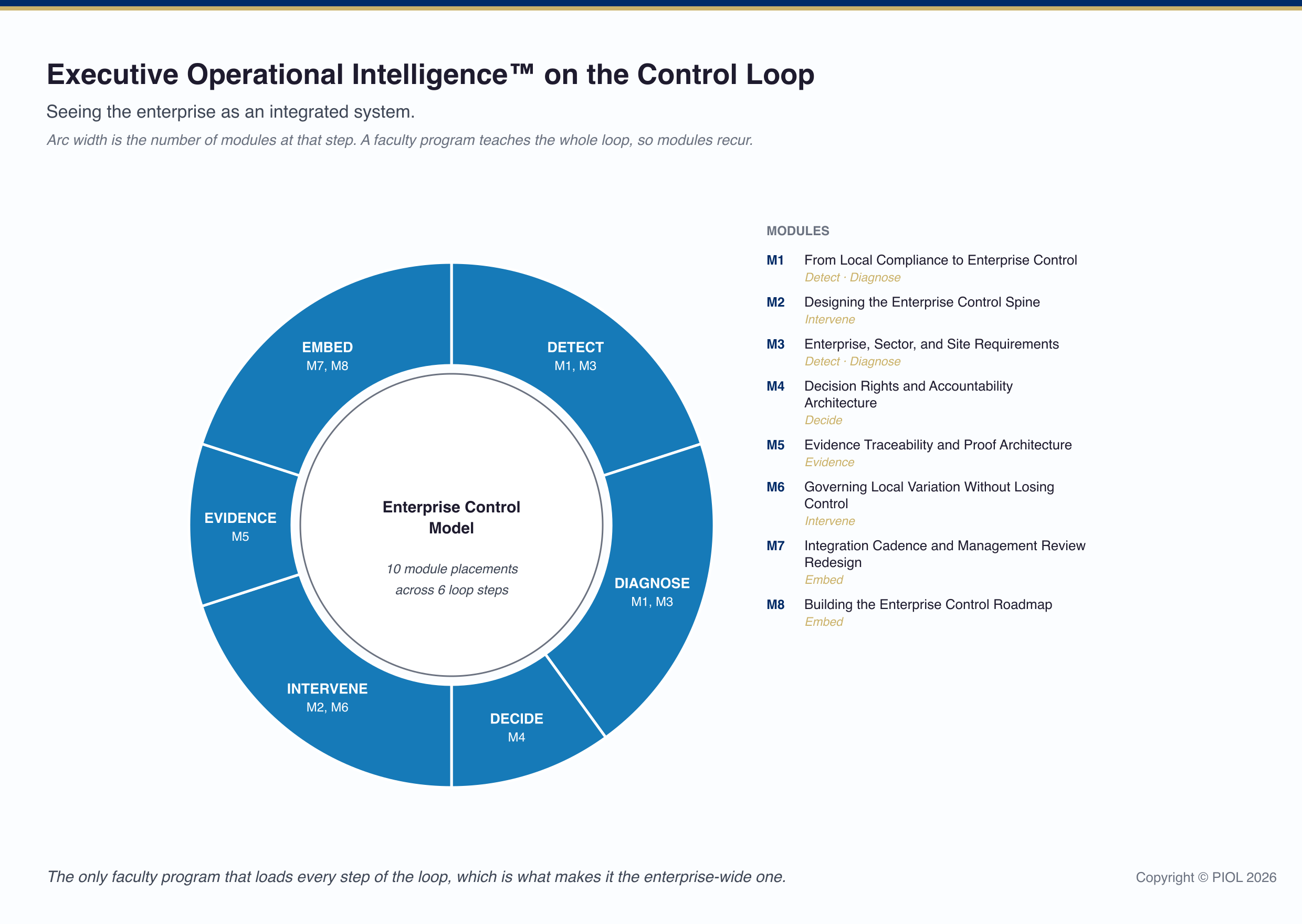
Executive Operational Intelligence™ on the Control Loop
A faculty program teaches the whole executive control loop rather than a sequence, so its modules return to the same steps from different angles. The width of each arc is how much of the program sits there.
Curriculum
10 modules · 28 lessons
- Why Everything Passes and Nothing Connects9 minPreview
- Certification, Compliance, Readiness, Control9 min
- The Cost of Local Interpretation9 min
Includes: Quiz · Self-assessment · Field assignment · Worksheet
A taste: your free preview
Why Everything Passes and Nothing Connects
How an enterprise made entirely of well-run parts becomes something no one can see whole, and why clean local results are the reason rather than the reassurance.
The Founding Principle: An enterprise can only be controlled to the degree it can be seen as one thing.
Every principle that follows in this program is a way of making the enterprise visible as a single system. This is the conviction the whole course rests on: no executive controls what they can only see in pieces.
Introduction
There is a particular kind of report that should worry an executive more than a bad one.
Every location green. Every function compliant. Every audit closed. Every certificate current. Nothing overdue, nothing escalated, nothing outstanding. The enterprise, viewed through the sum of its parts, appears to be in excellent condition.
The difficulty is that the sum of the parts is not a view of the enterprise. It is a stack of local views, each one accurate within its own boundary and none of them designed to be added together. A leader reading that stack is not looking at their business. They are looking at twelve businesses that happen to share a logo, each reporting on itself, in its own terms, against its own understanding of what was being asked.
This is the condition this program addresses, and its defining feature is that it does not announce itself. Fragmentation shows up as success, distributed. Each part passes because each part was built to pass, and each part was built by capable people solving a real local problem well. Nothing in the reporting will tell you that the parts do not connect, because reporting is itself one of the things that fragmented.
Well-Run Parts Do Not Make a Run Enterprise
The instinct, on first encountering this, is to look for the weak unit. If the enterprise cannot prove control, surely somewhere a part is failing and hiding it.
Occasionally that is true. Far more often it is not, and the search for the failing part is itself the error. What produces fragmentation is parts performing well, independently, for long enough.
Consider how it accumulates. A business opens a second location, and the second location adapts the first one's approach to fit different equipment, a different labour market, a different regulator. Reasonable. It acquires a third, which arrives with a complete system of its own, built on different assumptions, and integrating it fully would cost more than the acquisition case allowed. Reasonable. A fourth is opened in a different sector with genuinely different obligations. Reasonable. Each decision is locally correct. Each is made by someone competent, for good reasons, with the information available.
After a decade of reasonable decisions, the enterprise has four ways of defining a significant issue, four thresholds for escalating one, four record systems, and four understandings of what closure means. No one chose this. No single decision produced it. It is the emergent result of many sound local choices that were never required to connect.
Fragmentation is not the accumulation of local failures. It is the accumulation of local successes that were never asked to agree with each other.
This matters because it changes the intervention entirely. If fragmentation were caused by weak parts, the answer would be enforcement: find the laggards, raise the standard, inspect harder. Applied to a business whose parts are all performing, enforcement produces resentment and theatre, because the people being corrected are not doing anything wrong by any standard they were given.
The Three Things a Fragmented Enterprise Cannot Do
Fragmentation is easier to recognize by its consequences than by its appearance. Three capabilities go missing, and they go missing quietly.
It cannot compare. Two parts report the same metric, and the numbers cannot be placed beside each other, because one counts events at detection and the other at confirmation, or one includes a category the other excludes. The comparison is still made, in meetings, constantly, and decisions are taken on it. The parts are not lying. They were never told which definition to use, because no one realized a definition was needed.
It cannot see a pattern. A problem occurs in one location and is handled well: contained, corrected, closed. The same problem occurs eight months later somewhere else and is handled well again by people who have never heard of the first occurrence. On the third occurrence it is still a local incident, competently managed. The enterprise has now paid three times for a lesson it has never actually learned, and its records will show three closed items and no unresolved issue.
It cannot prove. Someone from outside asks a specific question: show me that this control worked, in this part of the business, in this month. The answer exists. It exists in four systems, two of which require a person to interpret them, and assembling it takes eleven days and the attention of people who had other work. The proof was produced, and that is treated as the successful outcome. What it demonstrates is that the enterprise cannot prove control. It can only reconstruct an argument for it, slowly, under pressure, on request.
The third of these is the one that eventually reaches the board, because it is the one an outsider can see. Customers, regulators, and acquirers do not experience your enterprise as a set of well-run parts. They experience it as one entity that either can or cannot answer a direct question about itself.
Why It Stays Invisible From the Inside
An executive might reasonably ask how a condition this consequential goes unnoticed by people who are paying attention.
The answer is that every position inside the enterprise has a view in which things look fine. The site leader sees a site that performs. The function head sees a function that is compliant. The auditor sees a scope that passes. The report reader sees a page of green. Fragmentation is not hidden in any of these views. It lives in the space between them, and no role owns that space by default.
This is why it usually surfaces from outside, and why it surfaces late. The first party to look across the whole enterprise at once, with the authority to ask for proof and no obligation to accept a local answer, is frequently a customer conducting an audit, a regulator following a complaint, or an acquirer running diligence. They are not more perceptive than the executives who ran the business for a decade. They simply have the one vantage point the organization never built for itself.
The enterprise is legible to everyone in it, in pieces, and to no one whole. The first person to see it whole is usually a stranger, and usually at the worst possible moment.
One boundary is worth marking before the course goes further. Reading what an organization is telling you, separating a real signal from noise in the reports and behaviour that reach you, is the subject of Executive Organizational Intelligence™. This program starts one layer down, at the architecture that determines whether those reports can be compared at all. The flagship asks what is true here. This one asks how this enterprise is held together.
Executive Reflection
There is a version of this course that would treat fragmentation as an operational problem to be tidied up, and it would be worth very little. The reason to take it seriously as an executive concern is that fragmentation sets a ceiling on how complex a business can safely become.
Every enterprise has a size and complexity at which its connective tissue is sufficient. Below that point, growth is straightforward and control keeps up. Above it, each new part adds more surface than the architecture can hold, and the business begins to accumulate exposure it has no mechanism for detecting. Growth continues. Nothing breaks visibly. What changes is that the organization's ability to know its own condition degrades, quietly, in proportion to its success.
That ceiling is a function of architecture, and architecture can be designed. That is what the remaining modules do.
Executive Exercise: The Four Answers Test
Choose one requirement that genuinely applies everywhere in your business. Something ordinary is better than something exotic: how a significant issue is defined, when a problem must be escalated, what makes a corrective action complete.
Ask four different parts of the organization, separately and without preparing them, four questions:
- Definition. What counts as this, here? Where is the line?
- Record. Where is it recorded, and in what form?
- Threshold. What level of it requires telling someone above you, and who?
- Exception. Who can approve doing this differently, and where is that approval kept?
Write the four sets of answers side by side. Do not correct them, reconcile them, or indicate that a right answer exists. The variance is the finding.
Then ask the question that turns the exercise from interesting into useful: for each place the four answers differ, what does that difference currently cost us, and who would notice if it never got fixed? Some differences cost nothing and should be left alone, which is as important a finding as the others. Module 2 depends on being able to tell those two categories apart.
Key Insight
An enterprise made entirely of well-run parts is not a well-run enterprise. It is a set of local optima that were never required to agree, and the clean reports it produces are evidence of how each part performs rather than evidence of how the whole is controlled. The condition is invisible from every internal vantage point because it exists in the space between them, which is precisely the space no role owns.
Key Takeaways
Fragmentation accumulates through sound local decisions rather than through local failure, which is why searching for the weak unit finds nothing and enforcement produces resistance rather than improvement. Its symptoms are three lost capabilities: the enterprise cannot compare its parts, because they measure differently; cannot detect a pattern, because each occurrence is competently closed as a local event; and cannot prove control, because proof must be reconstructed by hand each time it is requested. All three stay invisible internally, since every position inside the business has a view in which conditions look sound, and fragmentation lives between those views. It is therefore usually first seen by an outsider with a whole-enterprise vantage point, at a moment of the outsider's choosing.
PIOL Principle #1: An enterprise made of well-run parts is not thereby a well-run enterprise; fragmentation is the accumulation of local successes that were never required to agree.
Want the rest of the course? Sign in or create an account, then enroll.
Ready to start?
$995 for full lifetime access. Full refund within 14 days if you've completed under 10% of the course.