Executive Intelligence™
Executive Governance Intelligence™
Designing Governance That Improves Decision Quality
Your committees meet reliably. That is not the same as deciding well.
Rebuild governance as decision infrastructure, so your forums improve decisions rather than record them.
Secure checkout via Stripe. Full refund within 14 days if you've completed under 10% of the course.
What you'll learn
- Diagnose whether your governance is designed to assure, to oversee, to control, or to decide, and price the estate you inherited in the senior hours it actually consumes.
- Inventory the decisions your institution actually makes, as distinct from the agenda items its forums are currently organized around.
- Place any decision at the right altitude using its consequence, the cost and closing window of reversing it, and who carries it if it is wrong.
- Identify the decisions nobody made: the ones settled by deadline, by default, by whoever wrote the paper, or by the absence of a body willing to own them.
- Separate what an institution reserves from what it delegates, and close the unallocated space between them where decisions are made by people nobody appointed.
- Write a mandate that binds, including the deadlock rule almost no organization has, and find where authority and consequence have separated.
- Design a forum's composition, information, and sequence so that the judgment you need is possible within it.
- Restructure submissions so a body chooses between live alternatives rather than confirming a conclusion reached before it convened.
- Detect ratification disguised as decision, and build challenge into the structure so that dissent does not depend on one person's willingness to be difficult.
- Replace minutes with a decision record that preserves the alternatives rejected, the assumption the decision rests on, and the condition that would reverse it.
- Review and measure decisions on their quality as made, with the information then available, rather than on the outcomes they happened to produce.
- Govern the portfolio itself, and sequence a redesign that returns senior capacity and survives your departure.
The problem this solves
Build the Machinery That Decides Well When the Person Who Usually Decides Well Is Not in the Room
Most organizations govern themselves impeccably by every measure they keep.
The forums meet on schedule. Papers arrive before the meeting. Attendance is recorded, actions are logged, obligations are discharged, and someone can demonstrate on request that the matter was considered by an appropriately constituted body. An organization can satisfy all of that and still make poor decisions year after year, and when it does, nobody can say where the fault sits. The process was followed. The paperwork is in order. The result was simply disappointing.
That is what happens when governance is designed as an assurance system.
Assurance is a legitimate purpose and it is not the main one. Governance has one output that matters to the business: it produces decisions. Which investments proceed, which risks are accepted, which exceptions are permitted, which problem gets attention this quarter and which waits. Everything else the apparatus generates is either an input to a decision or a record of one. And yet almost no organization measures the quality of the thing its governance exists to produce. It measures the machinery running, not the machinery working.
The organizations that do attempt to measure it usually measure the wrong thing, which is the outcome. A decision that produced a bad result is treated as a bad decision, and a decision that produced a good one is treated as vindication. Both readings are unsafe. Outcomes arrive late, carry a great deal of noise, and are substantially determined by events no forum could have known about. A governing body judged on outcomes is being judged on luck, and it will respond exactly as anyone would: by deciding defensively, by deferring what could be deferred, and by leaving no trace of reasoning that could later be held against it.
Executive Governance Intelligence™ treats governance as decision infrastructure and teaches senior leaders to design it accordingly. It answers a question that surfaces the moment an executive becomes accountable for decisions they will not personally make: does this organization decide well, and would I be able to tell?
This is not a course about committee structure, terms of reference, or governance codes. Those are the visible surface, and they are where governance redesign usually stops. The subject underneath is the architecture that determines what judgment is possible: which decisions this institution actually makes as opposed to the ones its governance is organized around, where authority sits relative to consequence, what a given room can and cannot see, why the format of a submission decides the outcome before anyone speaks, how structure quietly makes agreement cheaper than accuracy, and what has to be preserved about a decision for it to be reviewable at all.
Across eight modules you will build a single connected artifact rather than a set of unrelated tools. Each module contributes one part of the Decision Governance Architecture: the decision inventory, the authority architecture, the forum design, the challenge and dissent design, the decision record standard, and the measurement of decision quality. By the final module these assemble into a governance design for the organization you are actually accountable for, with a 90-day roadmap for putting it in place and for retiring what it replaces.
The program is written for executives who convene or sit on bodies that decide: chief executives and their teams, division and business unit leaders, chairs and non-executive directors, general counsel and company secretaries, operating partners, and functional executives with committee accountability. It is deliberately function-neutral. A founder with an operating committee and a Monday leadership meeting is governing an institution as surely as a listed company with a full committee structure, and the core modules are written for both. Two optional overlays extend the material for those who need them: one covering board, listed, and regulated environments, where the record becomes a legal instrument, and one covering groups, joint ventures, and acquisitions, where decisions travel through entities the executive does not wholly control.
The outcome is not more oversight.
It is an institution that decides well when the person who usually decides well is not in the room.
Who this is for
Three ways in
For yourself
Executives who chair or sit on committees that meet reliably and decide badly.
$995
For a cohort
Company secretaries, governance leads and L&D functions preparing a board or executive committee for redesign.
Thirty minutes, no obligation, to work out whether this is the right program before you put anyone through it.
Book a callFor your company
Groups adding forums faster than they are retiring them, and paying for both.
Volume pricing, invoicing and a written proposal. Buying seats directly is on the card above.
Request a proposalRequest a proposal
Tell us roughly what you need and we will send a written proposal. You do not need an account.
The method
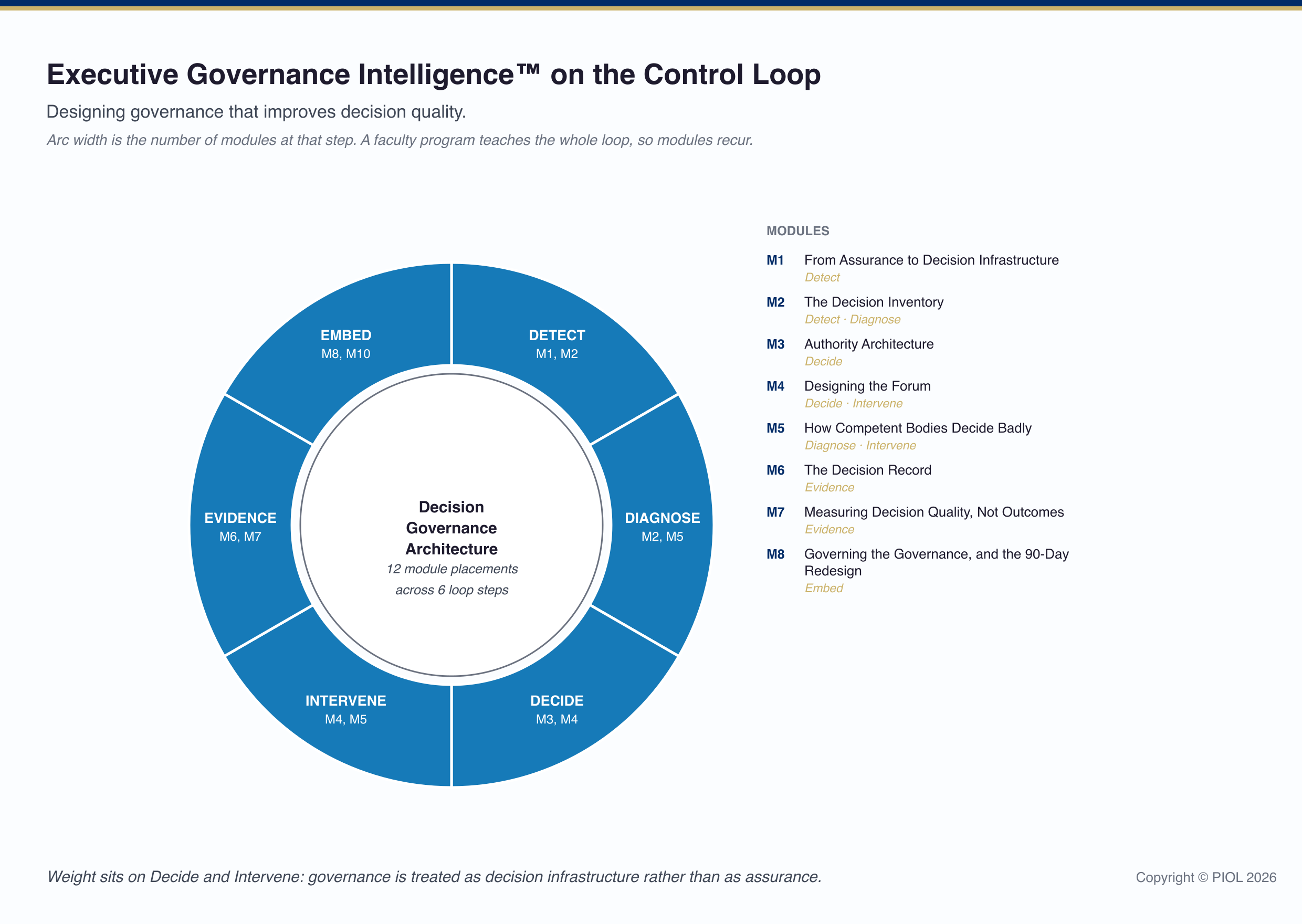
Executive Governance Intelligence™ on the Control Loop
A faculty program teaches the whole executive control loop rather than a sequence, so its modules return to the same steps from different angles. The width of each arc is how much of the program sits there.
Curriculum
10 modules · 28 lessons
- The Output Nobody Measures10 minPreview
- Assurance, Oversight, Control, and Decision10 min
- The Governance Estate You Inherited11 min
Includes: Quiz · Self-assessment · Field assignment · Worksheet
A taste: your free preview
The Output Nobody Measures
Governance produces decisions and is measured on everything except decisions. What follows from measuring the machinery running rather than the machinery working.
The Founding Principle: Governance is judged by whether it met, reported, and complied. It should be judged by the decisions it produced.
Everything in this program follows from that sentence. If it is true, governance is not an obligation to be discharged efficiently. It is infrastructure that manufactures a product, and infrastructure can be specified, instrumented, measured, and rebuilt.
Introduction
Consider the two accounts an organization can give of its own governance in the same year.
The first is written down. Committees met on schedule and made quorum. Papers were circulated in advance, and the proportion arriving late fell for the third consecutive year. Attendance ran above 90%. Actions were logged and closed. Terms of reference were reviewed. An effectiveness review was conducted and raised no material findings. Every obligation the organization carries in respect of how it governs itself was discharged, and someone can produce the evidence.
The second account is not written down anywhere. It is what a capable person who attends those meetings would tell you if they trusted you and were not being recorded: which body genuinely decides and which ratifies what was settled in a corridor beforehand, which papers arrive with the recommendation already written and the analysis reverse-engineered to support it, which risk has sat on the register for three years and been discussed nine times without once being resolved, who in that room can say the thing nobody wants to hear and who cannot afford to, and which decision from last quarter everybody privately expects to be quietly reopened.
Both accounts are accurate. They describe the same institution. Only the first one is measured, and the second one is the one that determines what the business does.
The One Thing the Machinery Makes
Governance has a single output that matters to the business. It produces decisions.
Which investments proceed and which are declined. Which risks are accepted, which are transferred, and which are simply lived with because no one wanted to raise the cost of removing them. Which exceptions are permitted and on what terms. Which of two initiatives gets the scarce senior attention this quarter. Whether a business is entered or left. Everything else the apparatus generates is either an input to one of those decisions or a record that one was taken.
That statement is not controversial when made out loud. What is striking is how completely it disappears from the way governance is actually assessed.
Look at what an organization typically knows about its own governance. It knows the cadence of every forum and whether the cadence was kept. It knows attendance, quorum, and the proportion of papers circulated by the deadline. It knows how many actions were raised and what share were closed on time. It knows that terms of reference exist and when they were last reviewed. In a regulated or listed environment it knows a great deal more, all of it structural. In a founder-led company or a professional services partnership the equivalent knowledge is less formal but the same in kind: the Monday leadership meeting happens, the partners meet monthly, the trading review is well attended.
Every one of those measures would still look healthy in a year of uniformly poor decisions. That is the defect. A measurement system that cannot distinguish a body making excellent judgments from one making terrible judgments is not measuring governance. It is measuring whether the machinery is running, which is a different question from whether it is working.
A governing body can discharge every obligation it carries and still be the reason the business is worse off.
Why the Output Goes Unmeasured
The gap is not carelessness. Three reasons hold it open, and each deserves an honest hearing, because a reader who thinks their organization is uniquely negligent will look for the wrong fix.
Decisions are unexpectedly hard to enumerate. You can count meetings because a meeting announces itself. Decisions do not. Many are never recorded as decisions at all: they appear in minutes as noted, endorsed, supported, or agreed to progress, formulations that are deliberately ambiguous about whether anything was chosen. Others are made outside the forum entirely and merely confirmed inside it. An organization that set out to count last year's decisions would find, within an hour, that it does not have a list and has no obvious way to build one. Lesson 2.1 addresses that directly, because nothing else in this program is possible without it.
The obvious substitute is the outcome, and the outcome is a poor instrument. If decision quality is hard to see, results are not, and the temptation is to judge the body by how things turned out. That substitution is so common and so damaging that Module 7 is built around dismantling it. For now it is enough to note that outcomes arrive long after the decision, carry a great deal of noise, and are substantially determined by events no forum could have known about. A body judged on outcomes is being judged partly on luck, and it will govern accordingly.
Nobody owns the question. This is the uncomfortable one. Internal audit, the company secretary, the compliance function, the chief of staff, or whoever plays those roles in a smaller business, are all accountable for whether the process was followed. That is a legitimate accountability and they generally discharge it well. None of them is accountable for whether the body reached good judgments, because that would require an opinion on the competence of people more senior than they are. So the question sits with the chair, who is also the person it would judge, and it is not asked.
What Follows From Measuring the Wrong Thing
Four consequences follow, and they compound.
The estate grows and never shrinks. If the output is unmeasured, there is no evidence on which any forum could ever be judged surplus, so none is. Bodies accumulate at the rate at which problems arrive, and they leave at no rate at all. Lesson 1.3 examines the mechanism that holds them in place and prices what the accumulation costs.
Bodies optimize for what is measured. Papers arrive on time. Actions close. The register is maintained and the effectiveness review is passed. None of this is fraudulent and most of it is done by conscientious people. It is simply that the observable target is the discipline of the process, so that is what improves, sometimes considerably, while the quality of judgment inside the room stays exactly where it was.
Decision quality becomes a personal attribute rather than an institutional one. Everyone knows which chairs run a body that decides well. That knowledge is real, and it is held entirely in reputation rather than in any system. It leaves with the individual. When a strong chair is replaced by a weak one the deterioration is severe, immediate, and unmeasured, and the organization will usually notice it two years later through an outcome.
Failure is attributed to the subject rather than to the machinery. A decision goes badly. The review that follows examines the market, the counterparty, the technology, the execution. It rarely examines the room: who was present, what they could see, what the paper permitted them to consider, how much time the item received, and whether anyone was structurally able to object. Those are the variables that were actually within the institution's control, and they are the ones the post mortem skips.
Consider how differently this reads across two organizations that look nothing alike. A listed company reviews its audit committee annually against a governance code and reports the result to shareholders; the review examines composition, independence, tenure, skills, and the frequency of private sessions, and says nothing about whether the committee's judgments were sound. A 60-partner professional services firm has no code, no external review, and a monthly partners meeting; it also has no view on whether that meeting decides well, and for exactly the same reason. One organization has an elaborate apparatus and the other has none. Both are measuring the machinery.
Where This Program Sits
Three boundaries define what this course will and will not do.
This program's object is the estate, not the forums you personally own. If you have taken Executive Organizational Intelligence™, its Module 3 already put a version of this question to you: name the specific decision each of your governance forums exists to enable, and retire the ones that enable none. That question is prospective, it is answerable by one executive about the bodies within personal reach, and it remains the right first move. This program asks the retrospective and institutional version. Not what each forum is intended for, but what the whole estate demonstrably produced over a period, what it cost to produce it, and in which room the consequential choices were really settled. The first question tidies a calendar. The second is the precondition for redesigning how an organization decides, which is work that has to outlive whoever is currently doing it.
The exercises in this module still start with the forums you attend, because that is where the evidence is cheapest to gather and where you can check your own answers. Lesson 1.3 widens the same instruments to everything in your scope, including the bodies you have never sat in.
This program is about the institution, not the individual. It designs the machinery so that an organization decides well regardless of who happens to be in the room. Improving your own judgment under uncertainty, how one executive reasons well from incomplete evidence and calibrates their own confidence, is the subject of Executive Decision Intelligence™. The two are complementary and they are not the same work. Where this program meets the ways individual reasoning fails, it treats them as constraints to design around rather than as a curriculum in thinking.
This program is about judgment, not transmission. Whether an issue reaches a decision-maker at all is a question about signal, escalation, and the conditions people are working in. That is the subject of Executive Organizational Intelligence™, and at the level of a single leadership team it is the subject of The Leadership Operating Model. This program begins at the point where the item has arrived and a body now has to decide. Where the architecture of enterprise control and integration cadence is the issue rather than the judgment itself, that is Executive Operational Intelligence™.
This program runs the house method. Every PIOL Executive Academy program follows the same six-step loop, and naming it here means you will recognize it rather than meet it unannounced:
The PIOL Executive Control Loop: Detect, Diagnose, Decide, Intervene, Evidence, Embed.
Modules 1 and 2 are Detect. Modules 2 and 5 are Diagnose. Modules 3 and 4 are Decide. Modules 4 and 5 are Intervene. Modules 6 and 7 are Evidence. Module 8 is Embed. The loop is the discipline; governance is the domain this program applies it to.
Executive Reflection
The discomfort in this lesson is not that organizations measure governance badly, but what becomes true once you accept that they do.
If the output is decisions and nobody measures decisions, then you cannot presently say whether the bodies you chair or sit on are adding judgment to this organization or subtracting time from it. Not because the answer is bad, but because the instrument does not exist. That is an unusual position for an executive to be in about something they spend a substantial share of their week doing.
Most executives already hold an unwritten version of the answer. Ask one privately which of their standing forums they would cancel tomorrow with no loss, and the reply is immediate and specific. The knowledge is not missing. It has simply never been written down, and it has never been written down because writing it down converts a private opinion into an obligation to act on it.
The question worth sitting with is not whether your governance is good, but what you would have to be able to show in order to answer that at all.
Executive Exercise: The Output Audit
Take the three or four standing forums you chair or attend most regularly. For each one, work through the last 90 days and list every decision it made.
Apply a strict test, and note that it is deliberately stricter than the familiar one. Counting the entries in a set of minutes that name a decision, an owner, and a date is a reasonable measure of whether a forum transacts, and Executive Operational Intelligence™ uses it that way. It is too generous for this purpose, because a body can produce well-formed minute entries all year while choosing nothing. Two additional conditions apply here. A decision is a point at which a course of action was chosen from among alternatives, and at which something in the business changed as a result. An item that was noted, presented, discussed, endorsed, supported, or agreed to progress does not qualify unless you can name what changed. Neither does an item where the choice had already been made elsewhere and the forum confirmed it, however properly that confirmation was recorded.
Then answer four questions about what you have written.
How long is the list? Most executives are surprised by how short it is relative to the hours consumed. Record both figures: the number of decisions, and the number of senior hours the forum consumed over the quarter, counting preparation and attendance.
How many of those decisions could only have been made by that body? If another body, or one person acting alone, could have made it as well or better, the forum is a route rather than a decider.
Which of them has since been reopened, quietly reversed, or not implemented? You do not need a reason yet. Just mark them. If you have worked through The Leadership Operating Model, you already recorded this against your own leadership team's decisions; carry that column across rather than rebuilding it, and extend it to every forum in scope. What that program read as evidence about behavior, this one reads as evidence about the body: a decision that does not stay decided was either not the body's to make or was not actually made in the room.
What did the forum spend the rest of its time on? Whatever that is, it is what the body is actually for, whatever its terms of reference say.
Keep the result. Lesson 1.2 gives you the vocabulary to name what those forums are doing when they are not deciding, and Lesson 1.3 turns the hours figure into a cost you can put in front of people.
Key Insight
Governance produces one output that matters, which is decisions, and almost no organization measures it. What organizations measure instead is whether the machinery ran: cadence kept, quorum made, papers on time, actions closed, obligations discharged. Every one of those indicators would remain healthy through a year of uniformly poor judgments, which means they cannot distinguish a body that decides well from one that does not. The gap persists for three structural reasons rather than through negligence: decisions are genuinely hard to enumerate, the obvious substitute measure is the outcome and the outcome is a poor instrument, and no function in the organization is accountable for the quality of judgments made by people more senior than itself. What follows is an estate that only ever grows, bodies that improve at the measured discipline rather than at deciding, decision quality held as a personal reputation rather than an institutional property, and post mortems that examine the subject of a decision while skipping the room that made it.
Key Takeaways
Every organization can give two accounts of its governance, and only the structural one is written down and measured, while the unwritten one determines what the business actually does. The single output that matters is decisions, and the standard indicators of governance health are all indicators of process discipline, which is why they would survive a year of bad judgment untouched. Decisions resist counting because minutes are deliberately ambiguous about whether anything was chosen, because many decisions are settled outside the forum and confirmed inside it, and because no list exists to start from. Substituting the outcome for the decision is the common escape and a damaging one, since outcomes arrive late, carry heavy noise, and reflect events no forum could have known. Nobody owns the question of whether a body decides well, because answering it requires an opinion on the competence of more senior people, so it sits with the chair and goes unasked. The consequences compound: forums accumulate because an unmeasured output leaves no evidence on which any of them could be judged surplus, bodies optimize for the measured target, quality of judgment leaves the building with a strong chair, and failure reviews examine the market rather than the room. This holds identically in a listed company with a full committee apparatus and in a partnership with none, because the defect is in what is measured rather than in how elaborate the structure is.
PIOL Principle #1: A governing body's output is decisions. Any measure of governance that would still read healthy through a year of poor decisions is measuring the machinery running, not the machinery working.
Want the rest of the course? Sign in or create an account, then enroll.
Ready to start?
$995 for full lifetime access. Full refund within 14 days if you've completed under 10% of the course.