Executive Intelligence™
Executive Decision Intelligence™
Making High-Quality Decisions Under Uncertainty
You were appointed for your judgment. Nobody has ever measured it.
Find out how good your judgment actually is, and make it measurably better.
Secure checkout via Stripe. Full refund within 14 days if you've completed under 10% of the course.
What you'll learn
- Recognize the number your language already implies, and the gap between the certainty you intend and the certainty your colleagues act on.
- State a belief about an uncertain outcome as a quantity and a range, in a form that can later be shown to have been right or wrong.
- Establish a calibration baseline for your own judgment, and score it as your stated judgments resolve.
- Build a reference class in a business that holds no formal data, using its own history, the sector's visible record, and adjacent analogues.
- Recognize when the outside view is the wrong instrument, including genuine structural change and cases with too few comparable examples.
- Price what a study, a pilot, or a month of delay is worth against the decision it would actually change.
- Identify information you can already predict you will not act on, which is the most common waste in executive practice.
- Design a consequential commitment as a sequence of stages, each with what it must prove before the next is funded.
- Judge what an option costs to hold, and when deliberately removing your own ability to change course is the instrument that makes a choice work.
- Build a profile of your own errors from logged judgments rather than from self-description, and know which of them are stable enough to design around.
- Judge when intuition is genuine evidence, based on whether the environment was regular enough and feedback fast enough to have taught you anything.
- Reason about a counterparty who is also deciding, including what your move teaches them and how the calculus changes when you will meet again.
The problem this solves
Turn the Instrument You Are Paid For Into One You Can Actually Measure
You were appointed for your judgment. You almost certainly cannot tell anyone how good it is.
That is not a personal failing, and it is not for want of experience. The evidence that would settle the question is systematically unavailable. Results arrive years after the decisions that caused them, thoroughly contaminated by events nobody could have anticipated. By the time they land, the reasoning that produced them has been quietly revised to fit what happened, because that is what memory does. What a long career leaves behind is a reputation, which is a summary of outcomes and the stories that got told about them. It leaves almost no record of the judgments themselves.
So the most valuable professional instrument you own is the one you have never measured, cannot compare against anyone else's, and have no method for improving beyond the slow accumulation of years.
Consider what that would be unacceptable for anywhere else. No organization would run a critical process on an instrument that had never been checked against a standard, on the grounds that it had been in service a long time and seemed to be working.
The obstacle is not effort or honesty. It is that judgment is normally expressed in a form that cannot be checked. Likely. Confident. A real possibility. Low risk. Those words feel precise to the person saying them and are decoded differently by every person hearing them, which is why a project gets resourced for one level of certainty while the executive who approved it privately held another. A statement that cannot be checked cannot be wrong, which is comfortable, and it also cannot be right, cannot be compared, cannot accumulate into a track record, and cannot improve.
Executive Decision Intelligence™ treats judgment as a trainable, measurable instrument rather than as a trait you either have or lack. It answers a question most executives have never been able to put to themselves: how good is my judgment actually, and what would make it better?
This is not a course in statistics, and it does not ask you to become an analyst. There are no formulas in it. What it asks is that you say what you believe as a quantity rather than a posture, and then do the unglamorous work of finding out whether you were right at the rate you claimed. Everything else follows from that one move.
Across eight modules you build a single connected practice rather than a set of unrelated tools. You will state beliefs as quantities and begin scoring them. You will learn to consult the cheapest evidence available, which is what happened to comparable efforts, before commissioning the expensive kind. You will price what a study, a pilot, or a month of delay is genuinely worth against the decision it would change, and recognize the most common waste in executive practice, which is buying information you can already predict you will not act on. You will design consequential choices as sequences rather than single commitments, and learn when removing your own ability to change course is the instrument that makes a choice work. You will build a profile of your own errors, which are patterned, stable across years, and invisible from the inside. You will reason about counterparties who are deciding about you. And you will learn to hold all of it as a portfolio, in which the unit of account is a year of decisions rather than any single one, together with the one exception that breaks that logic entirely.
The program is written for executives whose calls commit the business: chief executives and their direct reports, managing partners, division and business unit leaders, operating partners, and founders past the point where they decide everything personally. It is deliberately function-neutral. Quantified belief is native to investing and insurance, and this course is not written for those disciplines or from their examples. It assumes you are numerate in the way any senior executive is numerate, which is not the same thing as being quantitative.
One thing is worth saying plainly rather than discovering later. A calibration score requires judgments that have resolved, so the instrument this course builds matures over a year rather than over a weekend. You start it in the first module and you will be reading it long after you finish. That is the nature of the subject, and any course that promised otherwise would be selling you something that does not exist.
The outcome is not more confidence.
It is confidence worth something, because it has been checked.
Who this is for
Three ways in
For yourself
Executives appointed for their judgment who have never had evidence about it either way.
$995
For a cohort
L&D leaders building decision quality into a senior development track rather than a workshop.
Thirty minutes, no obligation, to work out whether this is the right program before you put anyone through it.
Book a callFor your company
Executive teams that decide together and want a common standard for what a good decision looked like at the time.
Volume pricing, invoicing and a written proposal. Buying seats directly is on the card above.
Request a proposalRequest a proposal
Tell us roughly what you need and we will send a written proposal. You do not need an account.
The method
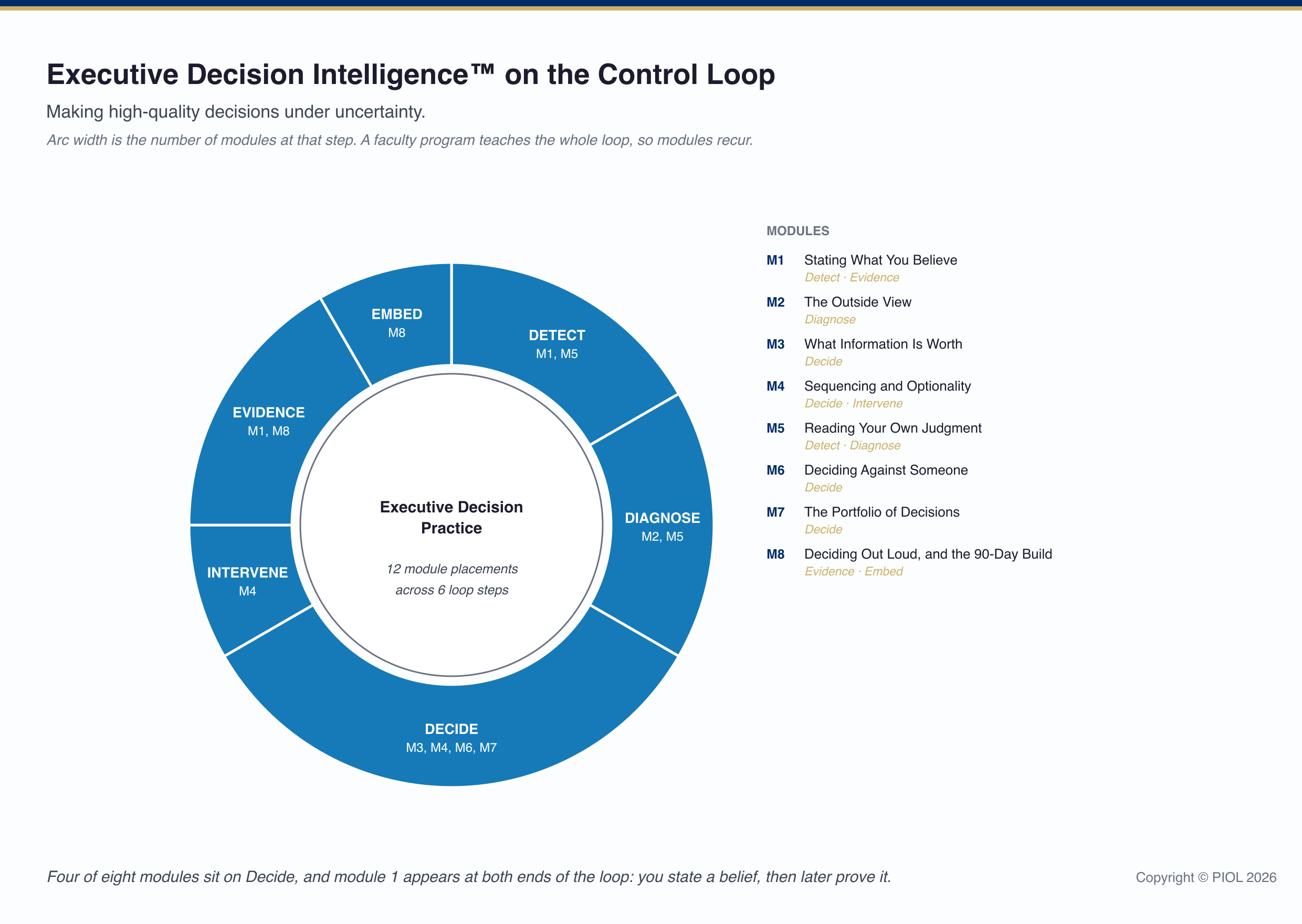
Executive Decision Intelligence™ on the Control Loop
A faculty program teaches the whole executive control loop rather than a sequence, so its modules return to the same steps from different angles. The width of each arc is how much of the program sits there.
Curriculum
10 modules · 28 lessons
- The Number You Are Already Implying11 minPreview
- From Position to Probability11 min
- Are You Any Good at This?12 min
Includes: Quiz · Self-assessment · Field assignment · Worksheet
A taste: your free preview
The Number You Are Already Implying
Every statement about an uncertain future implies a quantity, and if the speaker does not supply it the listener will. Why the words executives use are not a shared scale, and what the vagueness is protecting.
The Founding Principle: Every executive judgment already contains a number. Refusing to say it aloud does not make the judgment safer, it makes it impossible to check.
Everything in this program follows from that sentence. If it is true, judgment is not a trait you either have or lack. It is an instrument that produces measurable output, and an instrument that produces measurable output can be tested, compared, and improved.
Introduction
A managing director closes an update on the largest programme in the business with a sentence everyone in the room understands: "I'm confident we'll be live by the end of the quarter."
Nobody asks what confident means. There is no need, because everybody already knows.
The finance director hears something close to a commitment and releases the second tranche of funding, because holding it back would look obstructive against a confident sponsor. The commercial director hears a strong likelihood, tells two major customers that the new capability is coming, and books it into their renewal conversations. The operations director, who has worked with this managing director for six years and knows how he talks, hears roughly a coin flip and quietly keeps the old process staffed. The chief executive hears a professional assurance from a competent colleague and stops thinking about it entirely.
Four people, one sentence, four different numbers, and four decisions taken on the strength of them. Three of those decisions are now wrong, and it will be eleven weeks before anyone finds out which three.
The managing director was not careless. He was, if anything, being careful: confident was chosen precisely because it conveyed a strong position without committing to one. What he did not register is that the word does not carry a quantity from his head to theirs. It only invites each of them to supply one.
The Words Are Not a Shared Scale
Executives conduct almost all of their reasoning about the future in a vocabulary of perhaps a dozen words. Likely. Unlikely. Probable. Possible. A real risk. A good chance. Low risk. Significant exposure. We should be fine.
The vocabulary feels precise from the inside. It is not. Ask a roomful of senior people to write down the percentage they attach to likely and the answers will spread across a range wide enough to change any decision that depends on them. The same exercise run on a real possibility produces an even wider spread, and it is bimodal: some people read it as a warning that something might well happen, others as a reassurance that it probably will not. Both readings are defensible. That is the problem.
This is not a failure of vocabulary and it cannot be fixed by choosing better words, which is the usual first instinct. The words are doing exactly what natural language does. They convey a direction and a rough intensity, and they are calibrated to the speaker's own internal scale, which was set by that person's history, temperament, and professional culture. An engineer's probably and a salesperson's probably are not the same instrument, and they are not badly translated between the two. They are untranslated.
The consequence compounds in one specific direction. The more senior the speaker, the more consequential the listener's interpretation, and the less likely anyone is to ask what was meant, because asking a chief executive to put a number on confident sounds like a challenge to their competence rather than a request for information.
The Listener Supplies the Number, and Not at Random
If a statement about the future contains no quantity, the listener does not simply hold the uncertainty open. People are not able to do that, and would be poor executives if they were, because a decision has to be made and a decision requires something to decide against. So the listener supplies a number.
They do not supply it at random. They supply one consistent with what they were already inclined to do.
The finance director in the opening was not misled. He was given a word compatible with releasing funds, and he was already inclined to release funds, so he read it as sufficient. The operations director was given the same word, was already uneasy, and read it as insufficient. Neither of them was reasoning badly. Both were doing the only thing available when a statement carries a direction but no magnitude, which is to fill the gap from their own prior position.
This is the mechanism worth understanding, because it explains something otherwise puzzling: why unquantified confidence so reliably produces an organization that appears aligned and is not. Everyone agrees, because agreement is easy when the object of agreement is a word that each person has silently resolved into their own preferred number. The disagreement is real, it is present in the room, and it is invisible until something fails and everyone discovers they had been proceeding on different assumptions all along.
A statement that everyone can agree with, because everyone can interpret it, has not produced alignment. It has concealed the absence of it.
What the Vagueness Is Protecting
It would be convenient if this were simply a communication problem, correctable by encouraging people to be more precise. It is not, and the reason is worth sitting with rather than skipping.
Vagueness is protective, and the protection is real.
A statement that cannot be checked cannot be shown to have been wrong. I was confident survives any outcome, because the word was never pinned to anything that reality could contradict. I thought it was about seven in ten does not survive in the same way: if the thing fails, and if it fails alongside four other things you called seven in ten, a pattern becomes visible that was not visible before. Precision creates a record, and a record can be used.
Executives who have been in post long enough to watch a colleague be held to an unlucky call learn this quickly, and they learn it as a professional survival skill rather than as an evasion. The vocabulary of confident and likely is not laziness. It is a rational response to an environment that punishes stated positions that turn out badly while leaving unstated ones untouched.
So the honest framing of what this program asks is not that you should be clearer, but that you should voluntarily give up a protection, in exchange for something that protection was costing you.
What it was costing you is the subject of the next two lessons, and it is larger than it looks. Without a stated quantity, there is no record; without a record, there is no pattern; without a pattern, there is no way to know whether your judgment is excellent, adequate, or poor, and no way to make it better except by hoping that experience is teaching you something. The vagueness protects you from being wrong in public. It also protects you from ever finding out how good you are.
Where This Program Sits
Three boundaries, stated now because they define what this course is and, just as importantly, what it will not repeat.
This program is about you, not about the room. Improving how an institution decides, so that it decides well regardless of who is present, is the subject of Executive Governance Intelligence™: authority architecture, forum design, decision records, and how a body is measured. This program improves one executive's judgment. Where it reaches forums and records, they are your own practice rather than institutional design. That program also argues, at length, why outcomes are an unfair instrument for judging a decision. This course takes that argument as settled rather than making it again.
This program extends the flagship rather than restating it. If you have taken Executive Organizational Intelligence™, its Module 6 gave you a working discipline for deciding under uncertainty: the Mind-Change Test for identifying the fact that would flip a call, an assumption register with tripwires on the load-bearing beliefs, a grid for calibrating how much to deliberate against consequence and reversibility, and trigger bands for pre-committing to what would justify acting. Those instruments are sound and this course does not replace them. What they have in common is that they are qualitative: they ask you to name, write, and set, and none of them asks how likely. That is the whole of the difference. The flagship teaches you to decide well enough and correct. This program teaches you to find out how good your judgment actually is, which requires a quantity, a record, and time.
This program is about the choice, not about the world. Detecting an emerging risk before it becomes a failure is a sensing capability pointed outward and is the subject of Executive Risk Intelligence™. Deciding what to do about something you have already noticed is this. The two meet at rare, severe events, and Module 7 addresses those from the decision side only.
This program runs the house method. Every PIOL Executive Academy program follows the same six-step loop:
The PIOL Executive Control Loop: Detect, Diagnose, Decide, Intervene, Evidence, Embed.
Modules 1 and 5 are Detect. Modules 2 and 5 are Diagnose. Modules 3, 4, 6, and 7 are Decide. Module 4 is Intervene. Modules 1 and 8 are Evidence. Module 8 is Embed. This is the only program in the family that sits most heavily on Decide, which is what it is for.
Executive Reflection
There is a version of this lesson that is merely a point about communication, and it should be set aside first. That version says: be clearer, define your terms, make sure people understand you. It is true, it is minor, and acting on it would change very little.
The version that matters is harder. You do not speak in unquantified terms because the right words have not occurred to you. The unquantified version is genuinely safer for you, and you know it, and everyone senior around you knows it too. The vocabulary is a professional norm maintained by people who are not fools, because it works.
What it works at is protecting the individual. What it costs is any possibility of knowing whether the individual is any good at the thing they were appointed for. That is a real trade and it should be made deliberately rather than by default, which is the only thing this lesson is asking.
Notice, too, that you already make the trade in one direction without difficulty. You would not accept a supplier telling you that delivery is likely, or a finance function reporting that the year looks positive. In the places where you are the listener rather than the speaker, you demand the number as a matter of course, and you are right to.
Executive Exercise: The Implied Number
The Implied Number is the quantity a listener extracts from a statement that did not contain one. This exercise makes yours visible.
First, collect five statements. Go back through the last two weeks and find five things you said, in writing or in a meeting, about something uncertain in the future. Not predictions you were asked for formally, which you would have thought about, but ordinary working statements: we should be fine on that, there's a real risk with the supplier, I'd be surprised if they walk away. Write them down verbatim, or as close as you can.
Second, write your own number against each. What did you actually mean, as a percentage? Do this quickly and privately. First instinct is what you want, because the number you would produce after a minute's reflection is not the number you were holding when you spoke.
Third, and this is the exercise, ask two people what they heard. Choose one person whose position on the matter differed from yours and one whose position was aligned. Give them the sentence, not the context of this course, and ask what percentage they would attach to it. The phrasing that works is simply: when I said that, what odds do you think I was giving it?
Then compare the three numbers. Two things typically show up. The spread is wider than you expected, frequently 30 points or more on at least one statement. And the direction of the spread correlates with the listener's own position: the person who agreed with you heard a higher number than the person who did not.
Finally, for the widest gap, ask what was decided. Find one thing that person did, or did not do, on the strength of what they heard. That is the cost of the sentence, and it is usually the first time it has been visible to anyone.
Keep all five statements with all three numbers. Lesson 1.2 converts them into a form that can be checked, and Lesson 1.3 turns them into the first entries of a baseline.
Key Insight
Every statement about an uncertain future implies a quantity, and executives conduct almost all of their reasoning about the future in a vocabulary of a dozen words that do not carry that quantity between people. The words feel precise from the inside because they are calibrated to the speaker's own internal scale, set by history, temperament, and professional culture, and they arrive untranslated. When a statement carries direction but no magnitude, the listener does not hold the uncertainty open, because a decision requires something to decide against; they supply a number, and they supply one consistent with what they were already inclined to do. That is why unquantified confidence so reliably produces an organization that looks aligned and is not: everyone can agree with a word each of them has silently resolved into their own preferred figure. The vagueness persists because it is protective and the protection is real, since a statement that cannot be checked cannot be shown to have been wrong. It also prevents any record, and therefore any pattern, and therefore any knowledge of whether your judgment is good.
Key Takeaways
One sentence about a delivery date can produce four different numbers in four listeners and four decisions taken on their strength, with the error invisible for weeks. The vocabulary problem cannot be fixed by choosing better words, because natural language conveys direction and rough intensity calibrated to the speaker's private scale, and an engineer's probably and a salesperson's probably are not badly translated but untranslated. Seniority makes it worse, since the more consequential the interpretation the less likely anyone is to ask, because asking a chief executive to quantify confident reads as a challenge rather than a request. Listeners fill the gap from their prior position, which is not a reasoning failure but the only move available, and it means agreement on an unquantified statement conceals disagreement rather than resolving it. Vagueness is a rational professional response to an environment that punishes stated positions that turn out badly and leaves unstated ones untouched, so this program asks you to surrender a genuine protection rather than to correct a sloppy habit. The protection costs you the record, and without a record there is no pattern and no way to know whether your judgment is excellent or poor. Most executives already demand the number when they are the listener, from suppliers and from finance, which is the inconsistency worth noticing first.
PIOL Principle #1: An executive who will not state a number has not avoided making one. They have delegated it to every listener, each of whom will choose a figure consistent with what they already wanted to do, and then act on it.
Want the rest of the course? Sign in or create an account, then enroll.
Ready to start?
$995 for full lifetime access. Full refund within 14 days if you've completed under 10% of the course.