Executive Practice
Capital Allocation Under Operational Uncertainty
Funding in Stages, and Stopping Without Calling It a Failure
The money went somewhere. Almost nobody can say exactly where.
Fund in stages, and stop a commitment without it counting as a failure.
Secure checkout via Stripe. Full refund within 14 days if you've completed under 10% of the course.
What you'll learn
- Assemble where the money actually went, and compare the revealed portfolio to the stated strategy.
- Identify which commitments are continuing by decision and which are continuing by default.
- Read a business case as a document optimised for approval, and locate the number chosen to clear the hurdle.
- Build your organization's delivery base rate from its own record, and apply it to the next approval.
- Separate uncertainty that analysis can resolve from uncertainty that only execution can, and price the difference.
- Recognise the point at which commissioning further work has become a substitute for deciding.
- Design staged funding in which the tranche boundary is a genuine valve rather than a scheduled review.
- State what the next tranche of money has to buy, in observable terms agreed before it is released.
- Write stop conditions at the moment of funding, while nobody is yet invested in the answer.
- Design a withdrawal that its proposer survives, so that stopping stops being a career event.
- Reopen the run-rate through a rotating slice rather than an annual exercise that changes nothing.
- Run a standing forum that decides money, and retire the reporting it replaces.
The problem this solves
Your Strategy Is Not What You Said. It Is Where the Money Kept Going.
An executive program on committing money to initiatives whose outcome cannot be known in advance, and on the far harder act of withdrawing it once it has started to flow.
Every organization can produce a strategy document. Far fewer can produce the document that would settle whether they are following it, which is a list of where the money actually went, ranked by amount, over the last three years.
That second document is uncomfortable in a specific way. It usually shows a portfolio nobody chose. Not because anybody chose badly, but because the largest allocation decisions were never taken as decisions at all.
Approval is an event. It has a forum, a paper, a date, a discussion and a minute. Somebody stood up, somebody asked questions, somebody agreed. Continuation is not an event. It is the absence of one. Money keeps flowing into an initiative not because a person decided it should, but because stopping requires somebody to act and continuing requires nobody to do anything.
Capital Allocation Under Operational Uncertainty is built on the observation that follows from that asymmetry, and it is an observation about incentives rather than about rigour. Stopping is the only outcome in the system that has to be attributed to a person. An initiative that continues has no author. An initiative that is stopped has an executioner and a corpse, and the organization remembers both for years afterwards. So the personal cost of stopping exceeds the personal cost of continuing, for every individual at every level, including the ones with the clearest possible view of the evidence.
That is not weakness and it is not a failure of nerve, and treating it as one is why so many attempts to fix this fail. It is a correctly read incentive, and it will outlast any amount of encouragement to be more disciplined. The executive work is therefore not to choose better. It is to build a system in which withdrawal is an ordinary outcome that costs its author nothing, because the conditions for it were written down and agreed at the moment of funding, while nobody was yet invested in the answer.
The program is unusual in where it spends its time. Two of its eight modules are about money that is already moving: the commitments nobody ever reopens, which in most organizations is the large majority of the spend, and the withdrawal nobody will volunteer to propose. An executive who selects new initiatives brilliantly and has never stopped an old one has improved the smaller half of the decision, and the half that was already getting attention.
It is also clear about what it is not. It is not a corporate finance course. There is no discounted cash flow method here, no cost of capital derivation and no real options mathematics, and an executive completes the program without meeting a formula. The idea underneath real options is present, because staging is an option bought on information, but the executive version of it is a decision about where the tranche boundary sits and what the next tranche has to buy, which is a judgment rather than a valuation. It is not a budgeting course either. The annual cycle appears once, as the mechanism that renders most of the spend unexaminable, which is a criticism of it rather than an instruction in running it.
One boundary is worth stating plainly, since it defines the program. It does not teach decision quality. Stating a belief as a quantity, scoring whether you were right at the rate you claimed and profiling your own errors are the subject of Executive Decision Intelligence™, and this program cites it rather than restating it. The division is sharp and useful: that program owns the quality of the belief, and this one owns the money attached to the belief and the mechanism for taking it back.
The word doing the work in the title is operational. The uncertainty that decides most initiatives is not whether the market will be there or whether the estimate was unbiased. It is whether this organization, with the people and the attention it actually has rather than the ones the plan assumed, will do the thing it has funded. That question has an evidence base, the evidence base is your own delivery record, and in most organizations it has never been assembled, which is why every initiative is judged as though it were the first one the company had ever attempted.
Across eight modules you build one connected instrument. You will assemble where the money actually went and compare it to what you say your strategy is. You will learn to read a business case as the persuasion artifact it was written to be, and find the number that was chosen to clear the hurdle rather than derived. You will build your organization's own delivery base rate and discover what it does to the next approval. You will separate the uncertainty that analysis can resolve from the uncertainty that only doing can, and recognise the point at which commissioning more work has become a way of not deciding. You will design staged funding where the gate is a valve rather than a meeting. You will write stop conditions at the moment of funding, when they are cheap, and design the withdrawal so that the person who proposes it is credited rather than remembered. You will open the spend that is never reopened, using a rotating slice rather than the zero-based exercise that mostly consumes a quarter and changes nothing. And you will design a single standing forum that decides money rather than receiving reports about it.
Two optional overlays extend the material: one for executives allocating money that is not theirs, under an owner's clock and to somebody else's committee, and one for the spend that has no return line at all, where the benefit is an absence and the usual apparatus produces no answer.
The program is written for executives who commit money and are answerable for what it produced: chief executives, divisional and business unit leaders, finance directors who want the decision rather than the model, operating partners, and the transformation and programme leaders whose initiatives are the object of all of this, and who usually already know which ones should stop.
One thing is worth saying at the outset. This course will probably show you that a material share of your current spend was last examined by a person who has since left, that your organization has no record of how its previous initiatives actually turned out, and that nothing in your calendar would ever cause either fact to surface. That finding is uncomfortable and it is also the useful part, because money is easy to redirect in the quarter you notice and impossible to recover in the year you do not.
Who this is for
Three ways in
For yourself
Executives who commit money and are answerable for what it produced, including finance leaders who want the decision rather than the model.
$695
For a cohort
Finance and L&D functions raising the standard of the business case across everyone who submits one.
Thirty minutes, no obligation, to work out whether this is the right program before you put anyone through it.
Book a callFor your company
Groups with a portfolio of live commitments and no honest base rate for their own delivery.
Volume pricing, invoicing and a written proposal. Buying seats directly is on the card above.
Request a proposalRequest a proposal
Tell us roughly what you need and we will send a written proposal. You do not need an account.
The method
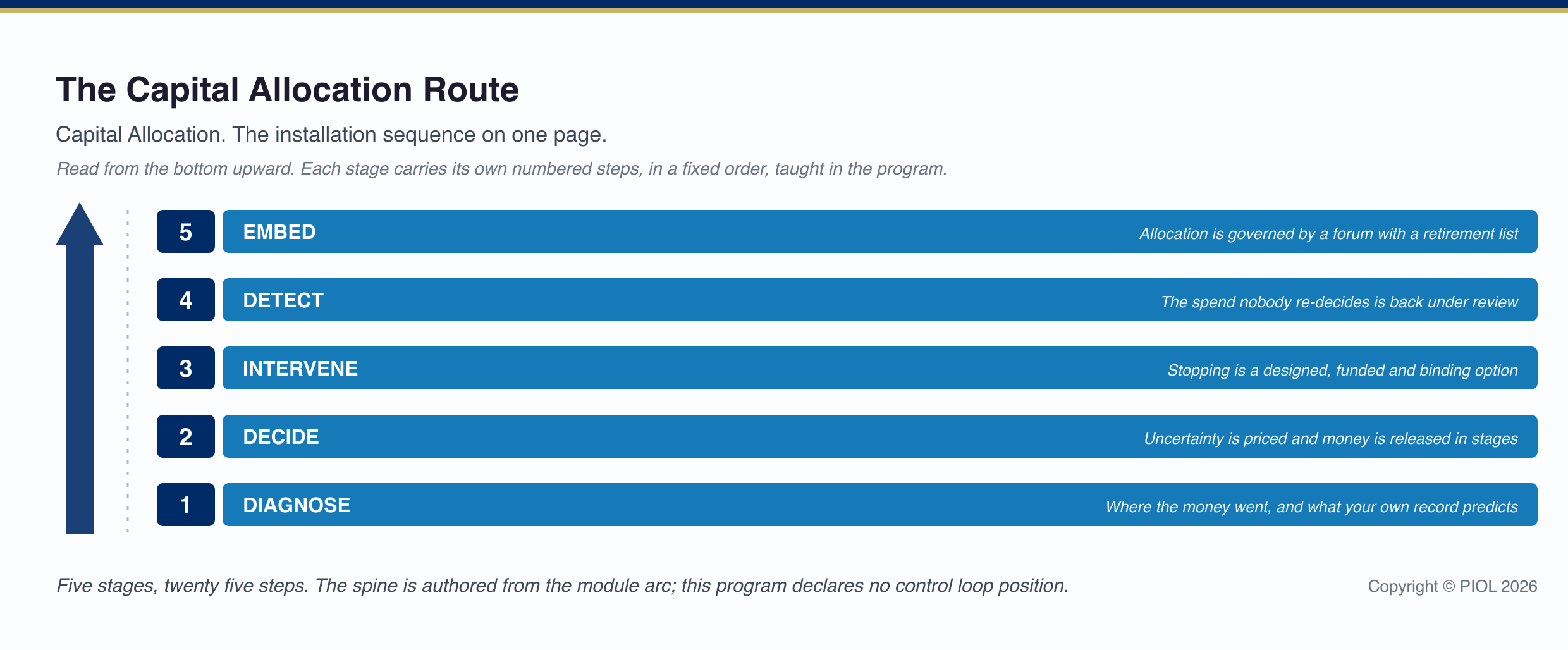
The Capital Allocation Route
This program installs a method in a fixed order. Each stage carries its own numbered steps, and each step produces something you keep.
Curriculum
10 modules · 28 lessons
- Strategy Is Where the Money Kept Going12 minPreview
- Approval Is an Event, Continuation Is a Default12 min
- The Portfolio Nobody Has Assembled12 min
Includes: Quiz · Self-assessment · Field assignment · Worksheet
A taste: your free preview
Strategy Is Where the Money Kept Going
Every organization has two strategy documents. One is written and circulated, the other is assembled from the ledger, and where they disagree the ledger is what is actually happening.
Introduction
Ask any executive team for its strategy and you will receive a document. Ask the same team for a list of where the money actually went over the last three years, ranked by amount, and you will receive a pause.
The second document is the strategy. Not in a rhetorical sense, and not as a criticism. It is the strategy in the only sense that has consequences, because it is the one the organization has been executing while the other one was being circulated.
Most executives accept that proposition immediately and have never assembled the document that would test it against their own business. That gap is the subject of this module, and closing it is the first deliverable of the course.
What the Revealed Portfolio Looks Like
The document does not exist as a report because nothing produces it. It has to be assembled, and the assembly is the exercise.
It is a list. One row per thing the organization is putting discretionary money and effort into, the amount committed to date, the amount still to come, and the date the commitment was last examined by a named person. Nothing more sophisticated than that, and it does not need to be accurate to two decimal places to be useful, because the finding is almost never marginal.
Three patterns appear with enough regularity to be worth predicting before you look.
The largest single line is usually maintenance of something the strategy does not mention. Not because the organization is neglectful, but because keeping an existing platform, estate or product alive is where the mass sits, and mass does not require advocacy.
The strategic priority is present but small. It exists, it has a name, it is on the list, and it is a fraction of what the language around it would suggest. This is the finding executives find most uncomfortable, because it is not a failure of commitment. It is what happens when a priority is added to a portfolio rather than funded from it.
A material share of the total is going into things nobody in the room can immediately explain. Initiatives approved by predecessors, extensions to extensions, and commitments whose original rationale is now carried by one person who has moved on.
Why the Two Documents Diverge
Three mechanisms produce the gap, and none of them involves anybody making a bad decision.
Strategy is set in one currency and executed in another. The strategy is stated in themes, ambitions and positions. Money is committed in projects, headcount, licences and contracts. Nothing in most organizations translates between the two, so the strategy can be agreed unanimously and then have no consequence for what gets funded on Thursday.
New money is scrutinised and old money is not. Every organization has a threshold above which a new commitment attracts a paper, a forum and a challenge. Almost none has any mechanism that applies comparable scrutiny to a commitment already in flight. So the portfolio drifts in one direction: things are added carefully and removed almost never.
And the strategy is announced while the allocation is quiet. A strategy launch is an event with an audience. A budget line continuing at its prior level is a row on a spreadsheet that nobody reads aloud. The organization therefore hears the strategy and experiences the allocation, and where those differ, people follow the second one, correctly, because it is the one attached to their resources.
The Test That Settles It
One comparison does most of the work, and it takes an afternoon rather than a project.
Take the top three priorities in the current strategy. Find the share of the last three years of discretionary spend that went to each. Then find the largest single line in that spend and check whether it appears in the strategy at all.
The output is usually a set of percentages nobody has seen before, and a largest line that is absent from the document. That is not evidence of a bad strategy or a bad finance function. It is evidence that the two are not connected by any mechanism, which is a design problem rather than a performance problem, and design problems are fixable.
A caution worth stating, because the exercise can be misused. The finding is not that maintenance spending is wasteful, or that the largest line should be smaller. Keeping the existing business running is usually the correct largest line, and an organization that starved it in favour of its strategy would be making a much more expensive mistake. The finding is that the proportion was never chosen. It is the residue of decisions taken years apart by people who were not comparing them to each other, and a proportion nobody chose is unlikely to be the one they would choose.
Why This Is the First Module
The rest of the course is about how single decisions are made: how a case is read, how uncertainty is handled, how money is staged, how commitments are stopped. None of that is worth much to an executive who cannot see the portfolio those decisions are shaping.
There is also a practical reason for starting here. The allocation picture is the artifact that makes the argument for everything else. An executive who proposes staged funding, or stop conditions, or a rotating review of the base, is proposing process, and process is resisted. An executive who puts a single page on the table showing that 60% of the last three years went to two things nobody has examined since 2023 is not proposing process. They are describing a condition, and the process arrives as the obvious response to it.
Try This Before the Next Lesson
Write down what you believe the top three lines of discretionary spend are, before you look. Seal it. The gap between the guess and the answer is the most informative number in the exercise and it is only available once.
Then ask whoever holds the ledger for the actual list. Expect it to take longer than it should, and expect to be offered something organised by cost centre instead. That difficulty is the finding of Lesson 1.3 arriving early.
And pick the largest line you did not expect, and find out when a named person last examined it. Not when it was last reported on, and not when its budget was last approved as part of a total. When somebody last considered whether it should continue.
Key Insight
Every organization has two strategy documents: the one that is written and circulated, and the one that could be assembled from the ledger as a ranked list of where the money actually went. The second is the strategy in the only sense that has consequences, because it is what the organization has been executing while the first was being discussed. The assembled document is unglamorous, needs no precision to be useful, and predictably shows three things. The largest single line is usually maintenance of something the strategy does not mention, because mass does not require advocacy. The stated strategic priority is present but far smaller than the language around it implies, which is what happens when a priority is added to a portfolio rather than funded from it. And a material share is going into commitments nobody currently in the room can explain, made by predecessors or extended incrementally, with the original rationale held by somebody who has since moved on.
Key Takeaways
Three mechanisms produce the divergence, and none of them requires anybody to have decided badly. Strategy is set in themes and executed in projects, headcount, licences and contracts, and in most organizations nothing translates between the two currencies, so a strategy can be agreed unanimously and change nothing about what is funded. New money is scrutinised and old money is not, so the portfolio drifts in one direction only. And the strategy is announced while the allocation is quiet, so people follow the allocation, correctly, because it is the thing attached to their resources. The test that settles it takes an afternoon: find the share of three years of discretionary spend that went to each of the top three stated priorities, then find the largest single line and check whether the strategy mentions it. The finding is not that maintenance is wasteful, since it is usually the correct largest line. It is that the proportion was never chosen, because it is the residue of decisions taken years apart by people who were not comparing them.
PIOL Principle #1: An organization's strategy is not the document describing it but the pattern its spending reveals. Where the two disagree, the spending is what is happening, and the proportion between them was almost never chosen by anybody.
Want the rest of the course? Sign in or create an account, then enroll.
Ready to start?
$695 for full lifetime access. Full refund within 14 days if you've completed under 10% of the course.