Executive Practice
After the Deal
What to Integrate, What to Leave Alone, and in What Order
The value was in the model. The deal team has moved on.
Protect the value the deal assumed, by deciding what to integrate and what to leave alone.
Secure checkout via Stripe. Full refund within 14 days if you've completed under 10% of the course.
What you'll learn
- Reconstruct the operating assumptions a deal was priced on, and identify which of them currently have no owner.
- Convert each assumption into a named decision with a date, rather than leaving it as a claim in a model.
- Assign every system, process and standard one of three dispositions: integrate, leave alone, or decide later with a trigger.
- State honestly what leaving something alone will cost, so that the decision is a trade rather than an avoidance.
- Name what the deal actually bought, in terms specific enough that somebody could damage it by accident.
- Identify the routine integration steps most likely to remove that thing, and protect it against your own programme.
- Settle day-one decision rights for the acquired entity, and distinguish approvals that bind from approvals that advise.
- Establish which obligations transferred at completion, and which records that would evidence them did not arrive.
- Price the cost of retrofitting proof, and decide deliberately where not to.
- Sequence the integration so that the first thirty days carry what cannot wait and the first year is not spent on what could have.
- Read what the acquired organization concluded about you in its first month, and what your next acquisition will read from this one.
- Run a standing review of integration decisions rather than of milestones, and retire the reporting it replaces.
The problem this solves
The Integration That Destroys the Most Value Is the One That Goes Exactly to Plan.
An executive program on acquisition integration: what happens to an acquired business between completion and the operating model, and the decisions that decide whether the price paid was justified.
A deal is priced on a model.
Inside that model are assumptions: that these two customer bases overlap, that this capability can be sold through that channel, that a cost line comes out, that the acquired business keeps doing the thing it was good at. Every one of those assumptions is a claim about an operating decision somebody will have to take after completion.
Almost nobody owns those decisions.
The deal team disperses within weeks. The integration becomes a workstream with a plan, a governance forum and a status colour. And the assumptions that carried the value are never converted into anything a named person does differently on a Tuesday. They are not rejected. They are simply never allocated, and eighteen months later they are quietly restated as having been optimistic.
What happens in the meantime is not a mystery, and it is not incompetence. Integration defaults to standardisation, because standardisation is legible, plannable and reportable. It produces a milestone chart that a board can follow. Nobody in that process is asked the only question that matters, which is which differences did we just pay for, so the differences are removed on schedule, by capable people, doing exactly what they were asked.
After the Deal is built on the observation that follows from that. A failed integration is visible: it slips, it costs, it gets attention, and somebody fixes it. A completed integration that standardised away the thing the deal was for produces a clean status report, a closed programme and a permanent loss that nobody ever attributes to it. The second is far more common and far more expensive, and it is invisible precisely because everything went according to plan.
This program is therefore unusual in what it spends its time on. Two of its eight modules are about what not to integrate: naming what the deal actually bought, and protecting it against your own programme. That balance is deliberate, because an acquirer who sequences well, allocates authority cleanly and retrofits every missing record, while standardising away the capability that justified the price, has run an excellent integration of a business that is now worth less than it was.
It is also clear about what it is not. It is not a diligence course: everything here starts at completion, and what to pay and what to ask before signing belong to somebody else. It is not a project management course either. There is no integration office methodology here, no workstream taxonomy and no benefit-capture tracker, and that matters commercially as well as intellectually, because the moment this subject reads as that apparatus it is delegated to an integration office, which is exactly where integration decisions go to become milestones instead of judgments.
And it is not about integrating faster. Speed is the instinct, and it is frequently the error, because speed and standardisation are the same reflex wearing different clothes.
One boundary is worth stating plainly, since it defines the program. It does not teach enterprise control. What must be common across an enterprise, how variation is governed, how a control spine is designed and how evidence is made traceable are the subject of Executive Operational Intelligence™, and this program cites it rather than restating it. The distinction is sharp and useful: that program designs the spine. This one decides which parts of an acquired business join it, in what order, and which must be left off.
Across eight modules you build a single connected instrument rather than a set of tools. You will write down what the model actually assumed, which is frequently the first time anybody has, and find how many of those assumptions have no owner. You will give every system, process and standard one of three dispositions rather than letting the default carry them all. You will name what you bought, in terms specific enough to defend, and identify the routine integration steps that would remove it. You will settle who decides what from day one, which is the first thing that has to be real and usually the last thing written down. You will establish what obligations transferred at completion whether or not anybody read them, and what it costs to rebuild the records that did not arrive with the business. You will sequence the work, because the first three moves set what everything after them costs. And you will read what the acquired organization has already concluded about you, which it decided in the first month and decided from what you did rather than what you announced.
Two optional overlays extend the material: one for joint ventures, minority stakes and earn-outs, where the decisions are identical and the authority to take them is not, and one for serial acquirers, where a second deal arrives before the first is finished and the thing that has to survive is the pattern rather than the plan.
The program is written for executives on the acquiring side after completion: chief executives and divisional leaders who have just absorbed a business, operating partners in private equity, corporate development leaders who still own the model's assumptions after the deal team has moved on, and integration leads who have been handed a plan and no authority. It is also bought, in smaller numbers and with unusual motivation, by executives inside an acquired business, and it works unchanged from that side.
One thing is worth saying at the outset. This course will probably show you that your integration plan contains no decision about what to leave alone, that the assumptions the deal was priced on are not written down anywhere a current employee could find them, and that both of those were true of the last one as well. That finding is uncomfortable and it is also the good news, because a plan is easy to change in month two and impossible to unwind in month twenty.
Who this is for
Three ways in
For yourself
A chief executive, divisional leader or integration lead holding a model whose assumptions the deal team has moved on from.
$695
For a cohort
Corporate development and L&D functions preparing integration leads before completion rather than during it.
Thirty minutes, no obligation, to work out whether this is the right program before you put anyone through it.
Book a callFor your company
Serial acquirers, where the same decisions recur and the playbook is currently in somebody's head.
Volume pricing, invoicing and a written proposal. Buying seats directly is on the card above.
Request a proposalRequest a proposal
Tell us roughly what you need and we will send a written proposal. You do not need an account.
The method
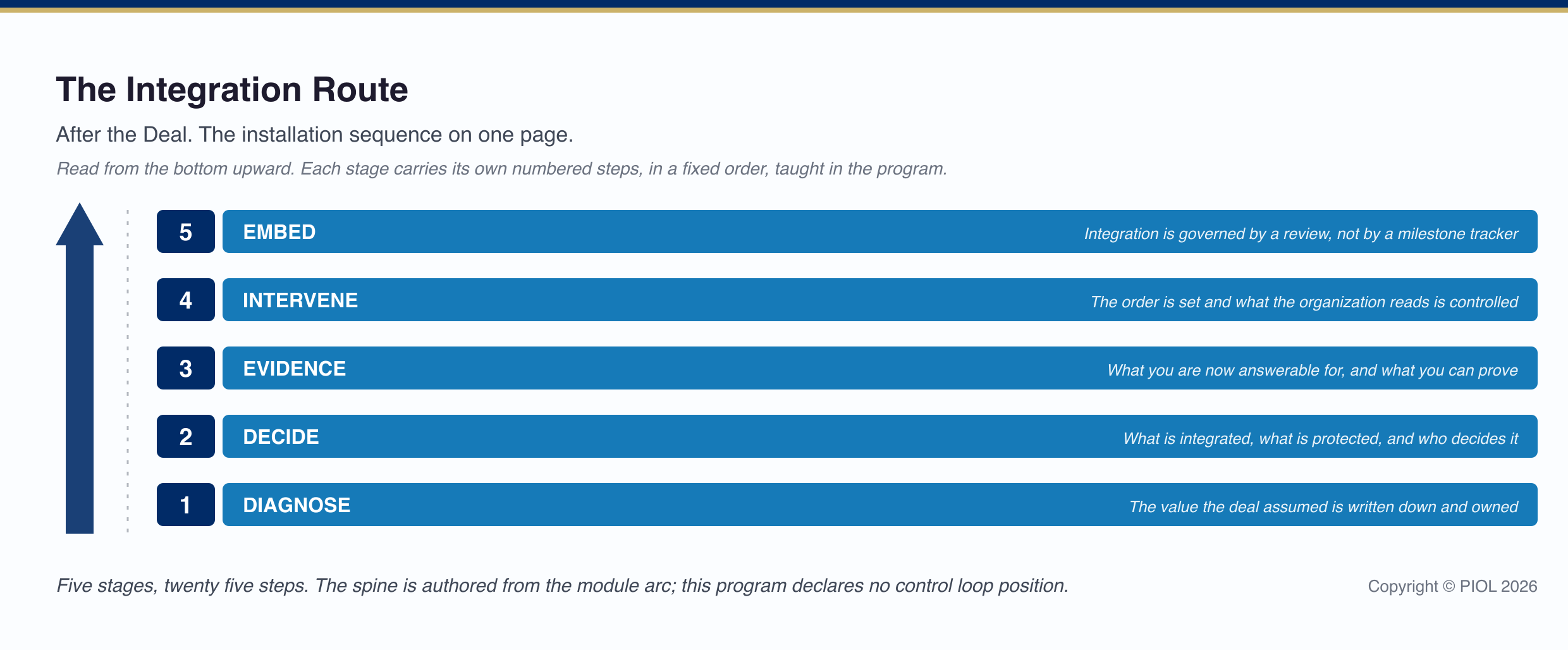
The Integration Route
This program installs a method in a fixed order. Each stage carries its own numbered steps, and each step produces something you keep.
Curriculum
10 modules · 28 lessons
- What the Model Assumed and Nobody Owned12 minPreview
- The Hundred Days That Were Never Planned12 min
- Where the Value Actually Leaks12 min
Includes: Quiz · Self-assessment · Field assignment · Worksheet
A taste: your free preview
What the Model Assumed and Nobody Owned
Every number in a deal model rests on an assumption about an operating decision somebody will have to take after completion, and the people who made those assumptions have left by the time anybody could act on them.
Introduction
Somewhere there is a spreadsheet. It justified the price.
Inside it are lines that look like arithmetic and are not. A cost line comes out in year two. A cross-sell rate of some percentage is achieved by year three. A facility consolidates. A capability is sold through a channel it has never been sold through before.
None of those are forecasts in the way the model presents them. Each one is a claim that a specific operating decision will be taken, by somebody, at some point after completion, and that it will work.
Founding Principle: A deal is priced on a model, and every assumption in that model is a claim about an operating decision somebody will have to take after close. The deal team disperses before any of them are taken, so the assumptions that carried the value are never converted into anything a named person does differently.
Where the Owners Go
The structural problem is one of timing, and it is nobody's fault.
The people who built the model are the people who leave. Corporate development, the bankers, the advisers, the deal team. Their work ends at completion, which is the exact moment the assumptions become operational. In most organizations the handover is a document and a meeting.
The people who inherit it were not in the room. The divisional leader who now runs the acquired business, and the functional leaders who will be asked to deliver the changes, generally did not build the model and frequently have not read it. They inherit a target, which is the output of the assumptions, without the assumptions.
And the target survives while the reasoning does not. This is the part that does the damage. The number stays in the plan, in the board pack, in somebody's objectives. The reasoning behind it, which is where the operating decision was specified, is in a slide deck on a shared drive that nobody opens after the first month.
So the organization ends up holding a commitment whose mechanism it cannot reconstruct. When the number is missed, there is no way to say whether the assumption was wrong or the decision was never taken, and in the absence of that distinction the default explanation is that the market moved.
The Reconstruction, and Why It Is Worth Two Hours
The remedy is unglamorous and takes an afternoon.
Get the model. Not the board summary. The working file, with the lines that add up to the price.
For each material line, write the operating decision it assumes. One sentence, in the form: this number requires that somebody decides X, by Y. A cost line requires a decision about which site, which contract, which roles. A revenue line requires a decision about which channel, which product, which pricing authority.
Then write who owns that decision now. A name, not a function. In most reconstructions, a third to a half of the material lines have no name against them at all, and that is the finding the exercise exists to produce.
And write the date by which it has to be taken for the number to be achievable on the timeline the model assumed. This is where the second finding usually appears, which is that several decisions needed to be taken before anybody got round to reconstructing them.
What the Reconstruction Reveals
Three things, reliably, and none of them is a surprise once seen.
Some assumptions were never decisions at all. They were hopes expressed numerically. A cross-sell assumption with no decision behind it, no channel change, no incentive change, no pricing authority, is a forecast that the world will simply become more convenient. Naming it as such early is worth a great deal, because it is the line that will be defended longest and delivered last.
Some decisions belong to people who cannot take them. The decision requires authority across both businesses, and the person holding it has authority in one. Module 4 is about this specifically, and it is the single most common structural failure in the first hundred days.
And some assumptions contradict each other. The cost case assumes a consolidation that the revenue case assumes will not disrupt the customer relationship. Both were modelled separately by people optimising their own line, and nobody holds the pair. This is invisible in the model and obvious in a register.
The Objection Worth Answering
The common objection is that models are directional and that treating each line as a commitment is naive. It is partly right and it does not survive contact with what happens next.
Directional is exactly what the model is, at the point of signing. What makes it more than that is that the number is then transferred, unchanged and undirectional, into a plan, a set of objectives and a board expectation. Nobody re-derives it. Nobody widens it back into a range. It becomes a commitment through inheritance rather than through decision.
So the reconstruction is not an attempt to hold the deal team to a spreadsheet. It is an attempt to recover the reasoning before the number outlives it, which it will, and usually within a quarter.
Try This Before the Next Lesson
Take the last acquisition, whether it closed last month or three years ago.
Find the model and list its material lines. Six to twelve is normal. If you cannot find the model, that is a more serious finding than anything else in this lesson and it is more common than it should be.
For each, write the operating decision, the owner and the date. Two hours for the whole thing. Do not consult the deal team yet, because what you can reconstruct without them is the measure of what the organization actually holds.
Then count the blanks in the owner column. In most reconstructions it is a third or more, and every one of them is a number somebody is still expecting.
Key Insight
A deal is priced on a model whose lines look like arithmetic and are not. Each material line is a claim that a specific operating decision will be taken by somebody at some point after completion and that it will work. The people who made those assumptions are structurally the people who leave: the deal team's work ends at completion, which is the exact moment the assumptions become operational, and the handover is usually a document and a meeting. The people who inherit them were not in the room, did not build the model and frequently have not read it, so they inherit a target, which is the output of the assumptions, without the assumptions themselves. The target then survives while the reasoning does not, leaving the organization holding a commitment whose mechanism it cannot reconstruct, and when the number is missed there is no way to distinguish a wrong assumption from a decision nobody took.
Key Takeaways
The reconstruction takes an afternoon and needs the working model rather than the board summary. For each material line, write the operating decision it assumes in one sentence, who owns that decision now as a name rather than a function, and the date it must be taken for the number to be achievable on the modelled timeline. A third to a half of material lines typically have no name against them, and several decisions typically needed taking before anybody got round to the exercise. Three findings recur. Some assumptions were never decisions but hopes expressed numerically, and a cross-sell line with no channel change, incentive change or pricing authority behind it is a forecast that the world will become more convenient. Some decisions belong to people who cannot take them, because the decision needs authority across both businesses and the holder has it in one. And some assumptions contradict each other, because the cost case and the revenue case were modelled separately by people optimising their own line and nobody holds the pair.
PIOL Principle #1: The people who make a deal's operating assumptions are structurally the people who leave at completion, and the number they produced outlives the reasoning that produced it. What the organization inherits is therefore a commitment whose mechanism nobody can reconstruct.
Want the rest of the course? Sign in or create an account, then enroll.
Ready to start?
$695 for full lifetime access. Full refund within 14 days if you've completed under 10% of the course.